Friday, December 21, 2007

Annual Review for 2007

Merry Christmas to any and all visitors, I hope Santa fills your Christmas stocking with; twelve Hilliards, eleven Coopers, ten Peales, nine Copleys, eight Dumonts, seven Isabeys, six Smarts, five Halls, four Englehearts, three Rogers, two Daffingers, and a George Washington by Ramage!!!

Review of 2007
The final comment in my review twelve months ago, of 2006 was;

"Overall the 2006 year is regarded as much more successful than was anticipated a year ago. As a consequence, it is felt at this point that it may be difficult to make quite as much progress during 2007."


Like many prophecies or forecasts, that was completely wrong, so obviously I had my rose-tinted opera glasses back to front!

As the subject of one of my recent posts, Mark Twain (see View), once famously said, "The art of prophecy is very difficult, especially with respect to the future."

Progress during 2007 year, while not "earth shattering", was more dramatic than during 2006, as can be seen from the slideshow below, with nearly double the number of acquisitions; 90 in 2007 compared to 47 in 2006.

This was largely due to more than a fair share of personal buying luck and a reluctance to miss potential bargains. (If necessary, please wait for the slideshow to appear, and click on it to open.)


The slide-show shows the 90 miniatures acquired this year. They are displayed more or less in the chronological order of the sitter's costume. The attribution to artists are on a "best endeavours" basis, so it is unlikely all attributions are correct.

Quality and Top Ten Favourites
As mentioned below, there is a target average cost of no more than $500 per miniature, as a purchasing discipline and to allow as much collecting pleasure as possible. Thus the average quality is less than would apply to another collector who has a bottomless wallet.

While there is nothing special about $500, as was mentioned last year, one aim of displaying this collection is the hope that it does demonstrate that one can assemble in a single year, an interesting collection of original art, at a cost no greater than what some wealthy collectors are willing pay for a single limited edition print, or even a single miniature portrait by John Smart!!

As previously observed, I suspect some purists would rather have a single John Smart miniature, than the 90 miniatures shown here, but I am convinced they would have not had as much pleasure in building their collection.

My favourite "top ten" acquisitions, but not necessarily in order of importance are:
- John Ramage - portrait of Garrit Van Horne - see View
- Johann Heinrich Hurter - portrait of I N S Allamand - see View
- Walter Robertson - portrait of a lady "C V" - see View
- Princess Amelia - portrait of King George III- see View
- Nathaniel Rogers - portrait of a man in a chair - see View
- Moses B Russell - portrait of a young lady - see View
- Moses B Russell - portrait of a man - see View
- Daniel Saint - portrait of a young lady - see View
- Alessandro Curion - portrait of a family - see View
- Mira Edgerly Korzybska - portrait of three sisters - see View

This list is subjective, as it does excludes miniatures by other good artists.

Research Favourites
Being a private collector enables one to be a "magpie" and buy, (cost permitting!!), whatever appeals. Thus there are all grades of miniatures, some being acquired more for the story behind the sitter, rather than for the artistic quality. Nevertheless, there is an underlying aim to gradually improve the average quality.

The most interesting to research have been;
- Thomas Hargreaves - portrait of Esther Watson Tobin - see View
- Princess Amelia - portrait of King George III - see View
- Unknown British - portrait of John Williams - see View
- Unknown British - portrait of Rev Bryan Faussett - see View
- John Ramage - portrait of Garrit Van Horne - see View
- Saint-Memin - portrait of Christopher Grant Champlin - see View
- Richard Morrell Staigg - portrait of Colonel Winchester - see View

Plus new research on prior year acquisitions:
- Unknown - portrait of Hon Augustus Henry Archibald Anson - see View
- Anna Coleman Watts Ladd - self portrait - see View
- Alta Eliza Wilmot - portrait of Mark Twain - see View
- Unknown American - portrait of Nathaniel Gilman - see View
- Riviere, Annette Louise - portrait of Nora Selina Dobell - see View
- Schenley, Henrietta Agnes - portrait of Henrietta Araminta Monck Browne - see View

However, dozens more have had research notes added during the year

Related Items
Apart from miniatures there were several interesting items acquired which were associated with sitters or artists.

One example is this rare book "Louisa Ralston" written by Anne Tuttle Jones Bullard, who is a sitter in a miniature within the collection, see View The wider collection now includes original volumes of four books written by her.

Cost of the Investment
All items were acquired from dealers or at public auction. An average cost of under $500 per miniature has been mentioned as a preferred guideline to stretch a limited budget.

I felt sure that guideline would be breached this year, as two miniatures each cost more than $2000 and others cost over $1000. The most expensive was the young lady signed by Moses B Russell, which cost $2300.

On working it out, the average cost of a miniature across the portfolio was $435, and I was surprised it was so far under the $500 guideline. (However, I can imagine other collectors might say; "I am not surprised, given some of the rubbish he purchased!")

From a personal point of view, variety is better than pure quality, as there is a lot more pleasure from buying and researching miniatures, than in attempting to invest a similar amount in the sharemarket (or for that matter, in sub-prime loans!!). And, anyway, collecting is a hobby and is supposed to be fun.

Any mathematicians reading this blog will have already calculated 90 times $435 as a total cost of around $39,000 which proves my shopaholic tendencies.

Budding art investors reading this blog, who wish to reach their own opinion on the success or otherwise of the acquisition strategy, can do so by working through the slide-show and attributing values to the items in the portfolio. (However, if the answer is a negative, please do not tell me!!)

Funding has come from disposing of miniatures and from savings, thus baked beans on toast continues to be on the menu. Like any other person terminally affected by the collecting bug, it is impossible to resist opportunities if they present themselves, even when there is a desire to avoid encroaching on savings.

As for the market outlook for portrait miniatures in 2008; "Who knows?". I have felt it was a little softer at the lower levels in 2007, compared to 2006, perhaps due to some sub-prime nervousness, and the Dow currently off its peak.

In contrast, at the top end of the market in 2007 there were some remarkable sales, including those mentioned in recent posts; Oliver Cromwell, Queen Elizabeth, and John White! Twelve months ago, who would have ranked White with Cromwell and Elizabeth?? However, they do reflect the rarity and uniqueness of certain items, especially for important sitters.

The other morning I heard Fox News suggesting that purchasing art was a positive alternative to investing in shares at the current time. However, their comments revolved around investing in new and emerging artists. That is something that is even more frightening to me than the sharemarket.

Personally, I expect to find it harder to make valuable acquisitions in 2008, but will hope to find some miniatures that are interesting to research.

My own New Year's Resolution is; "Buy Less and Sell More", but I recognise that as an obsessed collector I can rarely let an opportunity pass by.


Website/Blog for 2008
A continuing aim is to try and maintain this as a user-friendly website/blog.

Few Internet activities are more frustrating than accessing museum and auction house websites which are slow to respond, especially when one is accustomed to very fast downloads from both Internet auction websites and Google searches.

Some of the major live auction houses are dreadful in this respect and if any of them happen to read this, they should note that slow responses are very much a disincentive to bidding. So much so to me, that I now rarely visit their websites.

Museums and auction houses usually also have very cumbersome search facilities, which often require one to know specifically what one is looking for before searching for it. That makes general research for knowledge on a subject almost impossible.

Also with their websites, one often needs open a series of pages to see the detail. The probable reason for this, is that their systems were designed before fast download speeds became available. Whether there will be any improvement will depend upon each individual museum or auction house, but it seems unlikely in the near future.

Although this website is not purpose built and has been cobbled together, it does have a major compensating advantage of fast response times for downloads.

Once a visitor reaches the Artists and Ancestors Home page, they can see any miniature in the collection, together with all its research notes, by a single click on the relevant country Gallery, whether American 1, 2, or 20C, British 1, 2, or 20C, or European 1 and 2.

Then the complete contents of each Gallery can be scrolled through rapidly, or searched by using the Blog Toolbar at the top of each Gallery page.

Granted it would be impossible for a large museum or auction house to contemplate reaching any item in its collection, together with its image and all research notes, with a single click from its home page, but it should be possible to do so much faster and with many less clicks than they currently require.

The addition of slideshows and a search facility to the Home page impacted on its download performance. To compensate for this and enable faster downloading of the Home page, most of the background history and comment about miniatures has now been transferred to a Background Gallery.

As recent visitors have probably noticed, the Additions and Comment section has been split between 2006 and 2007 , to make these Galleries more manageable. A new "2008 - Additions and Comment Gallery" will be set up for 2008.

I am also conscious some Galleries in this blog are now quite large, with the inclusion of my verbose commentaries during the year.

The American Galleries are getting very large and need some attention. I am currently not sure whether to re-sort them completely (a major task), or just set up an American 3 Gallery for 2008.

Any readers (all two of you!) are welcome to comment on the current blog structure, (especially with criticisms!) and make positive suggestions, before I commit to changes for 2008.

Thursday, December 20, 2007

December 2007 - More from the Markets

The following auction snippets about American miniatures may be of interest.

Bonhams and Butterfields
On 29 Oct 2007 Bonhams and Butterfields offered this James Peale as lot 1026. It was described as "James Peale (1749-1831, American) Portrait miniature on ivory. Unidentified member of Bealle-Johnson-Bullein-Kelsall family dated 1785. Depicted facing right, wearing a powdered wig, black coat, vest and white cravat, signed IP 1785, within a 14k gold glazed pendant frame with glazed reverse on a 14k gold chain. Height of image 1 3/4in (4.5cm) Includes copy of letter of authentication from the Peale Family Papers, The National Portrait Gallery, Smithsonian Institution, Washington, D.C. Lillian B. Miller editor of 'The Peal Family Papers' attributes this miniature to James Peal for several reasons. Firstly the signature, IP with the date below matches his other known portraits. Secondly the tentative handling suggests an earlier work. Some of these early characteristics include an angularity of the face and the handling of the hair. By 1786 his brother Charles Willson Peale felt that James had sufficiently mastered his craft to leave the field of miniature portraiture solely to his brother."

Estimate: $8,000/12,000 - Auction result: Unsold

Bonhams
Sales by the major UK auction houses rarely include American miniatures, which is the major focus of this collection. However, in November, Bonhams of London offered a group of American miniatures and some of those are shown here.


Bonham's Lot 297 Two children and a dog by John Carlin, sold for GBP2700

Lot 298 Man, circle of John Wood Dodge, not sold

Lot 299 Four children, circle of John Carlin, not sold


Bonham's Lot 300 George Washington by Edward Savage, sold for GBP13,000

Lot 301 Man in dark coat, circle of James Peale, not sold. (subsequent advice by a kind visitor is that this is actually by Pierre Henri)

Lot 302 Man in grey coat by James Peale, sold for GBP7000


Bonham's Lot 303 Elias Vanderhorst by unknown artist, sold for GBP1100

Lot 304 John Brooks after Gilbert Stuart, not sold

Lot 305 English artillery officer by Archibald Robertson, not sold


Bonham's Lot 306 Young ensign by Anson Dickinson, sold for GBP2400

Lot 307 Young man, circle of Edward Greene Malbone, not sold

Lot 308 Young lady by Anson Dickinson, sold for GBP2000


Bonham's Lot 309 Man by Joseph Wood, sold for GBP2000

Lot 311 Man by Robert Field, sold for GBP5000

Lot 312 Lady, American school, not sold


Bonhams Lot 314 Man by Thomas Gimbrede, sold for GBP600

Lot 315 Man by Nathaniel Rogers, sold for GBP1600

Lot 316 Man by Thomas Seir Cummings, sold for GBP1800


Bonhams Lot 317 Man by George Catlin, sold for GBP1000

Lot 320 Man by Thomas Seir Cummings, sold for GBP3000

Lot 321 Young lady by Anson Dickinson, not sold

Lot 322 Young man by Thomas Badger, not sold

It is noticeable that most of those clearly attributed to artists were sold.

In all cases, buyer's commission and taxes need to be added to the hammer prices shown above.

None of the above miniatures were acquired for this collection.

Skinners
An unusual miniature sold by Skinners on 29 November with a hammer price of $750 was the one shown here.

It was described as "Portrait Miniature of a Two-Star General, possibly Massachusetts, 19th century, watercolor, gouache, and metallic pigments reverse-painted on oval glass, (paint losses to background), 2 1/2 x 2 in."

Wednesday, December 19, 2007

December 2007 - John Ramage Addition and Market Comment

Additions
As the year draws to the close, so do opportunities to purchase miniature portraits.

However, December has witnessed the acquisition of two American miniatures, one of them being an important miniature by John Ramage (1748-1802). It was acquired recently at a combined live and Internet auction conducted by a large auction house. It is engraved on the reverse; "Garrit Van Horne - Married to - Ann Margaret Clarkson - 16 Novr 1784".

The auction house had described it as; "A hand-painted portrait miniature brooch/pendant, the oval portrait depicting a fashionable gentleman within borders of beads and half pearls, inscribed to reverse and dated 1784. Length 4.5cm." Thus it was unattributed by them.

However, it looked like a Ramage and before the auction I also found an apparently identical miniature in the Manney collection, which is discussed further below.

Needless to say to anyone who has ever bid at an auction, the time; before the auction worrying who else might see it, during the auction worrying how high they might bid, and then during transit worrying about a safe arrival, which itself was much delayed by the Christmas rush, was very stressful.

Subsequent to the auction, I am very grateful for the expert opinion which has endorsed my tentative view that this miniature was painted by John Ramage.

The similar image shown being fig 187 in the Manney Collection, which now forms part of the collection of American portrait miniatures at the Metropolitan Museum of Art. Apparently Ramage did sometimes make multiple versions of his miniatures. For more on this see View

There is often confusion over attributions of miniatures to John Ramage and William Verstille and so the auction records can be confusing for these two artists.

A genuine Ramage miniature sold at auction, shown here in front and rear views, was this c1790 miniature of Nicholas Gilman (1755-1814) which was sold by Sotheby's as lot 865 on January 18, 2003 for a hammer price of $42,000 which was double the pre sale estimate.

Although, I have not yet checked, it seems likely that this Nicholas Gilman is related to the Nathaniel Gilman, depicted in a later miniature portrait in this collection, see View

In contrast, the oval miniature of a lady shown here was offered at auction by Freemans on Nov 17, 2007 as lot 2211 - a miniature portrait of Mary Wool, attributed to John Ramage and with an estimate of $10,000/15,000.

However, buyers doubted the attribution and at the auction it sold for a hammer price of $4500. The miniature is probably by William Verstille and the auction price is commensurate with Verstille as the artist.

Although their work is similar and they are often in similar scalloped frames, Ramage was a much better artist than Verstille.

John Ramage was born in Ireland, but in about 1772 settled in Halifax, Nova Scotia. By 1775 he had moved to Boston. In 1776 he went to New York and quickly became that city's leading miniature painter, a position he held for around ten years. In 1794 he moved to Montreal and died there in 1802.

Although I have not seen it written elsewhere, I feel sure that other commentators would have observed that John Ramage was probably the American equivalent in terms of local importance, to the British artist, John Smart.

Ramage is the artist who painted the most valuable miniature portrait ever sold. This was a miniature of George Washington which sold for $1,200,000. This also made it the most valuable painting in the world of any kind, on a per square inch basis!

The comparison is a little nebulous, but www.askart.com has calculated the Ramage at $382,000 per square inch, compared to the next most expensive American artist, Andy Warhol at $88,000 per square inch.

Since writing the above a knowledgeable visitor has provided some interesting extra comment about Ramage and his miniatures. This can be seen along with more detail on this miniature at View

Compared to the Ramage mentioned above, there is much less certainty about the attribution of the second addition to the artist John Wesley Jarvis (1780-1840).

This is the unframed oval portrait on ivory shown here. The basis for the attribution is the similarity of style to the framed miniature on paper shown here, which is signed and dated 1807 by John Wesley Jarvis. It was recently sold by Skinners for $2000.

A close up view of the unframed miniature, see View - reveals that the hair has been built up by a multitude of fine cross-hatched lines, such as would be adopted by an artist trained as an engraver, such as Jarvis was.

Alternatively, the miniature may be by one of Jarvis's contemporaries.

The ivory portrait appears much brighter, which is partly because the framed miniature on paper was described as "toned and foxed".

Market Comment

There have been several interesting miniatures sold recently.

A major surprise was an unframed miniature by the Australian convict and artist Thomas Watling (1762->1806). It was signed and dated 1792, the year Watling finally reached the colony in Australia, after being sentenced to 14 years for forging banknotes in Dumfries.

The miniature depicts John White, the chief surgeon for the First Fleet, the 11 ships that sailed to Botany Bay in 1786 to establish a convict settlement in Australia.

After his arrival, Watling made many drawings which form the basis of the important studies of wildlife, landscapes, and the indigenous people of Australia known as the Watling Collection, now housed in the zoological library of the Natural History Museum in London. He was pardoned in April 1797, see Watling, Thomas (1762 - ) Biographical Entry - Australian ...

The miniature was offered for sale by Gorringes in England on 6 December 2007, seeking an opening bid of GBP120 and with an estimate of GBP200/400. I was tempted to leave an absentee bid of GBP550, well over the estimate to have a good chance of winning, but in the event did not bid.

To the astonishment of everyone, me included, but excepting the two bidders concerned, there were 405 bids according to the eBay auction record, which took the hammer price to GBP90,000, say $210,000 including buyer's commission.

To the best of my knowledge, this is a new record price for any miniature sold at a combined live/eBay auction.

Comparison can be made with the Watling miniature in this collection.

This second miniature by Thomas Watling is shown here in front and rear views.

Also shown much enlarged is the signature "T W", which is faint as it was difficult to scan through the glass. The "T" and "W" are formed in exactly the same manner as the example from the miniature of John White, and as if by an engraver, which was Watling's profession. However, it is conceded the initials may be meant to be "J W" or "I W".

In Foskett, there are no other obvious contenders with the initials "T W" and working around 1795-1805, which appears to be the date of this case. Foskett observes that Watling was working in Calcutta in 1803, and this was presumably after being released in Australia.

More recent research notes that he returned to Britain in 1804 and presumably continued painting there. Given the ornate frame, it seems possible this second miniature dates from after his return to Britain.

When acquired, this second miniature was attributed to Thomas Watling and the sitter was said to be related to the Macquarie family who were early settlers in Australia. The rear does include initials which appear to read "M F". However, to date, no research has been undertaken to try and find an early Australian settler with the intitials "M F", but it seems a little unlikely that the sitter has an Australian connection.

However, if any researcher familiar with early Australian history, can suggest a suitable name, I would be very grateful. Of course, one obvious Australian explorer with the initials "M F", is the navigator and cartographer Matthew Flinders (1774-1814), but this sitter looks to be too old to be Flinders.

Wednesday, December 12, 2007

December 2007 - Decorative Copies and Museums

If there are portrait miniature experts with the time or inclination to read this blog, please be aware I really do welcome corrections or comment about the content.

Apart from recording my own research notes, the blog is trying to help to improve the general pool of knowledge on the subject, both for beginning and advanced collectors.

For this particular post, expert opinion will be even more welcome than usual. (Since writing this post, a knowledgeable person has contacted me and advises that they agree with most of the conclusions below, although they think the Viertel pictured is genuine.)

Every week I receive emails asking me about miniature portraits and I try to answer them to the best of my ability.

For example, sometimes a query may read; "This valuable miniature is signed and belonged to my grandmother, can you please tell me anything about it".

Many of the miniatures emailed to me are decorative copies and it is quite difficult for me to determine how best to tell people that I do not think a miniature they have is as rare or valuable as they had believed. However, I feel I need to try and tell them "like it is", otherwise there would be little point in commenting.

Most people are grateful for my time and effort in replying to them, but sometimes I do not receive any acknowledgement, which I usually take as an expression of disbelief that I have not endorsed their treasured heirloom as being by a famous artist!

Elsewhere in this blog, I have commented about decorative miniatures and fakes. In particular how signatures of famous artists were often used by copyists. However, I thought it is worth addressing the subject again, but without using the actual examples sent to me.

Instead, I have selected a museum catalogue, almost at random, and will comment on images within the museum collection. (I say almost at random, the main reason for choosing this particular catalogue being because it was small and would easily fit on my scanner!)

The catalogue is titled "Portrait Miniatures in the Royal Ontario Museum" and was published in 1981. It illustrates 50 miniatures from the ROM collection.

My intention in commenting on it, is not to expose the collection as a misrepresentation, but instead illustrate how some museum collections, although acting in good faith, can contain miniatures which are, in my opinion, decorative copies.

Therefore owners with similar decorative copies should not feel they have embarrassed themselves, by buying or owning a decorative miniature. They are in good company and it can be very difficult to be sure whether a miniature is an original or a copy.

Even so, I am aware of some people who knowingly collect decorative miniatures for the pleasure of each painting and the history associated with the sitters.

A very great advantage available to current researchers, is the ability to easily scan and exchange images over the Internet. This was not possible in 1981 when the ROM catalogue was prepared, but now allows different examples by a single artist to be compared, and critical likenesses or differences noted.

Suggested revisions to the opinions on specific miniatures as expressed below, are welcome, so I can modify the comments where necessary.

Appropriately modified, the comments may then help collectors to determine how to recognise decorative copies, why they should not necessarily rely on museum catalogues, and show how scholarly research can revise previous attributions.

Most of the examples illustrated by ROM do not show the frame the miniature is housed in and in my mind in evaluating a miniature portrait, this is the first matter to make a judgement on.

Apart from the identity of the sitter, there are three main elements in evaluating a miniature, the frame (xxx - where xxx may be 16C, 17C, 18C, 19C, or 20C), the portrait (yyy - with the same range), and the signature (zzz - again the same range).

Recently, I replied to one query with the comment; I guess that 90% of my initial judgement of any miniature is based upon the nature and date of the frame itself. That is, the shape, size, and material it is made of, the design of the reverse of the frame, and the nature of the glass covering the miniature.

Only after that point, do I look at the portrait itself to see whether the portrait agrees with the frame and supports that opinion, or disagrees with my opinion of the frame, meaning the miniature has perhaps been re-framed.

Re-framing is not rare, but it is quite uncommon. A major reason being the difficulty of finding a replacement frame of exactly the right size, especially with earlier miniatures, where there are no standard sizes.

However, it can happen where a frame is damaged or where an uncaring owner likes an old locket type case and decides to reuse it for a modern photo (!!!) - thus relegating the original miniature to a modern frame.

Thus, I adopt a strong test which says if the frame is "xxx", are there any good reasons to think the portrait is not "xxx", but is in fact "yyy".

The signature "zzz" only becomes relevant right at the end after I feel I have got the correct date for the frame and the portrait. It then acts as confirmation of an initial opinion, just as silver experts comment about silver hallmarks on "The Antiques Roadshow".

I have not presumed to comment upon plates 1 to 11 in the ROM catalogue, as my knowledge of that era is too limited, but it would not surprise me to learn that several are copies and thus not original works by the artists named in the catalogue.

However, in looking at the 39 plates in the catalogue numbered from 12 to 50, I think that as many as 20% are not by the artists nominated. I gain the impression that previous attributions have just been accepted, with some miniatures being attributed by relying on the signature alone, without evaluating the frame or the portrait.

The miniatures in question are addressed in turn. The opinions are mine, but I am very willing to correct them where expert opinion differs from my view.

Plate 16 described as "typical of the work of Antoine Vestier (1740-1824), to whom it is attributed". My reservations about this item are that the mouth is too small for the face and the quality does not look good enough compared to other works by this artist.

The reference to the mouth can be explained as follows. In every era, as in the 20C and 21C, there are big swings in fashions. With the mouth sometimes fashion is to accentuate it with lipstick, and sometimes fashion is to minimise it, perhaps as a tiny "cupid's bow". In most instances, the size of a sitter's mouth in a portrait will reflect the fashion at the date the original miniature was painted.

Thus if an earlier "large mouth" miniature is copied during a time when a "small mouth" is fashionable, the copyist will generally end up with a mouth which is the wrong size compared to the size fashionable at the time the original was painted. Less obviously, this may also apply to the size and shape of eyes and eyebrows.

Plate 20 is attributed to Augustin Ritt (1765-1799). The ROM description includes the comment; "the acquisition of one of his miniatures was a great accomplishment for the ROM". However, in my view, the frame marks this miniature as a 19C copy and the quality is far short of the quality of Ritt's work. To me the eyes are too large; overall it appears flat, whereas miniatures by top artists tend to appear three-dimensional. Many decorative miniatures were painted and housed in frames like this one.

Plate 23 and 24. ROM dates them at 1780-1790 and comments "we can safely attribute them to the French artist Villard (Villaud or Villair)". However, rectangular miniatures were rare before 1810 and the miniature is different in style to the example by Villair illustrated in Schidlof, which is in fact round.

Plate 27 is described by ROM as "painted in watercolour on ivory by John Smart." There are other Smart portraits in the ROM catalogue that look "right" for John Smart, but this one does not. The quality is not there and it looks as if it is probably a copy by another artist, of a miniature by Smart.

Plate 30 is apparently signed "el Canario" and thus attributed to Luis de las Cruz y Rios. He settled in Madrid about 1815 and died in 1850. As the costume of the sitter in this miniature dates to 1780-1790, it is unlikely to be by this artist. It gives the impression of being a laboured copy of another miniature, rather than a spontaneous original.

Plate 33 is attributed to Johann Carl Friedrich Viertel a Danish artist. The miniature is weak and does not appear to be well painted, but it is conceded that there is some resemblance to plate 1220 in Schidlof, so it may possibly be a correct attribution. Since writing this a kind visitor has commented "I think that the Viertel is absolutely genuine and typical, (as mediocre quality as most of his works)". Thus I was wrong to include it in this section, however I will leave the image here as an example of how differing opinions as to genuineness can achieve consenus through an exchange of views.

Plate 49 is attributed to Jeremiah David Alexander Fiorino (1797-1847). This also looks flat and the mouth seems too small for the period. This is on ivory, whereas he usually painted on porcelain.

It will be noted that, part from one example by John Smart, all the others of doubtful attribution are by European artists. This is a reflection that decorative miniatures were commonly created in Europe by copying originals and adding fake signatures, but much less often copied in Britain. Continental copies were often copied from monotone engravings, where the printed copy might be the reverse of the original. Hence many decorative miniatures are painted in different colours to the original and may be a copy based upon a mirror image.

Having made all these comments, I am conscious of the adage "people who live in glasshouses should not throw stones!" There are still several decorative miniatures in this "Artists and Ancestors" collection. For the most part these are gradually being weeded out and disposed of, but a few are kept for sentimental reasons! However, comments and corrections are always welcome!

Also, I should comment that it was very good of ROM to print a catalogue in the first place, as many other museums have not. ROM can also be assured they are not the only museum to have doubtful miniatures in their catalogues. It is possible ROM has altered some of its attributions since 1981, but the catalogue still circulates amongst readers who may feel entitled to rely upon the accuracy of the information within it.

In fact I will only make one criticism of ROM. That concerns a comment right at the end of the 1981 catalogue saying; "As this book was going to press, the ROM was informed of a generous bequest of 200 miniatures ... These miniatures and a number of other recently acquired examples will be published in the near future as a separate catalogue".

Well, here we are nearly 27 years later, and to the best of my knowledge ROM has not yet published the separate catalogue! If anyone from ROM reads this blog and is able to advise a publication date, I will gratefully add it here.

Sunday, December 02, 2007

December 2007 - Additions

The current year will soon start to draw to a close, but the pre Christmas lull gives an opportunity to record some additions which were a little delayed in arrival.

There are three miniatures, one each from America, Britain, and Germany. Also two art accessories which are associated with specific American miniature painters.

The first of these is a red leather miniature case from around 1825-1830. The case is not in good condition, but what is interesting is that it has a trade label for Daniel Dickinson printed on the interior silk. Unfortunately the case did not contain a miniature by the artist.

Enhanced and close up images are shown here. The inscription appears to read; "D Dickinson - Miniature Painter - at Earles - Chestnut above 5 - PHIL" . This means his studio was at Earles in Chestnut Street, Philadelphia".

From the reference at Inventory of Trade Cards at the American Antiquarian Society it appears that Earles Galleries sold looking glasses at 816 Chestnut Street in Philadelphia. The gallery was operated by the Philadelphia framer James S Earle & Son. Thus it seems probable Earles were the framers for portraits and miniatures by Daniel Dickinson.

The reference to "above 5", probably means that one should go up Chestnut St, i.e. up past "5th Street".
I have not been able to confirm that Earles had more than one shop in Chestnut St, but it would appear so, as further below the Metropolitan Museum quotes a reference to Earles at 169 Chestnut St.

Earle's must have been at 816 Chestnut St for some time, as a painting by Rembrandt Peale dated to 1808, is inscribed Earles Galleries 816 Chestnut St, see Rembrandt Peale / Portrait of Edward Shippen Burd of Philadelphia ... and in 1851 there is a reference to 816 Chestnut St at The Metropolitan Museum of Art - Works of Art: American Paintings ...

Some Internet references mention that Earles were photographers late in the 19C. This was a natural development for a seller of mirrors. A further reference at Robert Cushman Butler Collection of Theatrical Illustrations mentions Earl's (sic) Galleries in 1901 but it is not clear if they were still at 816 Chestnut St.

A kind visitor has pointed out that the Metropolitan Museum holds a leather case with a printed trade label for Daniel Dicksinson. The image is not available on-line to compare with this one, but according to the Metropolitan website the wording is different, as is the address for Earles. Their example reads "D. DICKINSON/ Miniature Painter/ at EARLES/ No. 169 Chestnut St/ PHILAD [on the rock-seat of a landscape scene of putto painting a miniature]".

Another kind visitor has advised that he possesses a printed trade card for Daniel Dickinson, with the same picture and wording as the one illustrated here.

In 2007 Earles are long gone and 816 Chestnut St is now occupied by a variety store, Super Dollar City However, it seems very likely mirrors are still available from this store, 200 years after Earles Galleries were selling mirrors at the very same address!

Earles did various types of framing, including the oval Victorian fabric and hair arrangement shown here, which has their trade label on the reverse, but is not part of this collection.

Update - A kind Earle descendent has provided the following extra information. "Earle's gallery, Earl's Gallery (sometimes misspelled), James S. Earle & sons Gallery, were all names for the same gallery. The gallery moved at least 3 times, moving as their wealthy patrons moved, to more "elite" areas. I"m an Earle, and have done research on their locations (by going through old newspapers for advertising and through old Philadelphia address books) and have the auction pamphlet from when they closed down during the early part of the Great Depression.

The first Earle came to Philadelphia from England as a gilder, worked for someone else for a year and then went into his own business of framing and gilding. Eventually added "looking glasses", did indeed do photographs (many of visiting actors and actresses) and went on to become a gallery, exhibiting great artists of the time from both Europe and America. For a time, the Earles were in partnership with Sully who did the art buying and added a certain authority to the gallery. They were friends and we have a few paintings of family members by Sully in early Earle frames. I believe EG was the first to exhibit a black american artist, Tanner."

Daniel Dickinson (1795-1866) was the younger brother of Anson Dickinson (1779-1852). Daniel studied drawing in New Haven, but in 1818 he moved to Philadelphia where he worked as a portrait and miniature painter until 1846, before settling in New Haven, CT in 1847.

In the Cincinnati Art Collection there is a similar case which includes a label printed on the interior silk of a case, but advertising Daniel Dickinson's brother, Anson. This can be seen as fig 46 on page 140 of Aronson. However, the design of that case is different.

Unfortunately the wording of the advertisement has not been transcribed into "Perfect Likeness" and the image is too blurred to be sure of the wording, but it appears to read "A Dickinson Miniature ...... NEW YORK".

Apparently, Anson Dickinson used such cases between 1825 and the early 1830's. Which of the brothers was the first to use them and/or if they ordered them together is not clear.

The second item associated with an artist is a porcelain painter's palette. This belonged to the miniature painter John Ramsier. The palette was purchased at an estate sale of his son Elmer Ramsier and is accompanied by a notarised letter of authenticity.

There are several miniature portraits by John Ramsier in this collection and so he most likely used this palette when he painted those miniatures.

The American miniature was acquired from Thomaston, ME. Initially, I had hesitantly attributed this miniature to William Hudson Jr (1787-1861) of Boston who was active in Boston from 1829 to 1856.

However, a kind visitor has since told me the miniature is by Walter R Herve, who was active in Boston in the late 1820's and probably into the 1830's. Hopefully, this attributed example will now help other collectors to identify more of Walter Herve's work.

The sitter can be confidently commented upon. He is Captain Benjamin Leach Allen (1803-1865) of Manchester, Essex, MA and his family tree is well documented, with this miniature already being copied to the Allen family tree on the Internet.

He was interim Mayor of Boston in 1853 during a contested election. He is referred to as a Captain, but has not been found in the census records, presumably because he was at sea. For more about the 1853 Boston Election and to see a sampler tapestry made by his mother-in-law in 1793 go to View

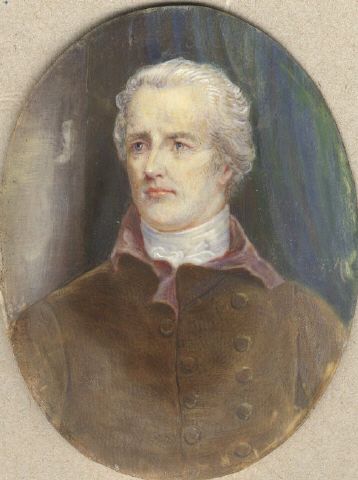
The British miniature of William Pitt the Younger is by an unknown artist. The miniature appears to be copied from an engraving, itself copied from a large oil portrait by John Hoppner of around 1805.

William Pitt the Younger (28 May 1759 – 23 January 1806) was the son of William Pitt the Elder (1708-1778), who was Prime Minister of Great Britain (1766-1768).

William Pitt the Younger was the youngest ever Prime Minister of Great Britain, initially between (1783-1801) and again between (1804-1806).

Miniatures of William Pitt are uncommon, but in this collection there is another miniature of Pitt painted by John Donaldson (1737-1801) from life, when Pitt was twenty years younger, see View

More about this second miniature and the original it was copied from can be seen at View

The last of this group of additions is a miniature of an unknown lady painted by Franz Till of Dresden in Germany around 1900.

It is painted on porcelain, but may possibly be on a faint photographic base. Even so the painting technique is difficult as the pigments change colour when fired in a kiln.

Although the identity of the sitter is unknown, it is known she was a patient at the famous von Hartungen health spa in the north of Italy.

This spa was frequented by many famous people of that time including Franz Kafka and Sigmund Freud. There is more information about the spa at View

Wednesday, November 28, 2007

November 2007 - Miniature Portrait of Mark Twain

Two miniatures by Alta Eliza Wilmot (1852-1930) have been sitting near the end of the American 20C Gallery for some time. I had not known anything about the artist, nor did she feature in the literature, so there was a very limited description.

One miniature portrait was of a lady and for the second, the vendor had remarked upon a similarity to Mark Twain, although this was not reflected in the cost, as the surface of the miniature is a little bit rubbed. For example there is a minor rub on the end of the sitter's nose.

However, this past week I have been contacted by a relative of Alta Eliza Wilmot with very helpful information about her and this has enabled me to identify the artist better and also encouraged me to research the two miniatures further. Information about Alta Wilmot can be seen at Wilmot, Alta Eliza - portrait of a lady

In summary, Alta Wilmot trained as a miniature painter after she became deaf and then she joined Aime Dupont (1842-1903), previously a photographer in Paris in 1870, but later with a studio in New York at the end of the 19C, with the Dupont studio continuing to operate at least until 1938.

Aime Dupont, a Belgian sculptor turned photographer and his wife, photographer Etta Greer, had moved to New York after having established a reputation as a portraitist of opera singers in Paris. His images were a sensation and Dupont quickly became the favorite of artists associated with the Metropolitan Opera Company.

In 1903 Aime Dupont died and his wife, Etta, took over the portrait business. The Metropolitan Opera Company did not long retain the contractual relationship with the Aime Dupont Studio after Etta assumed control, nor did it hire their son Albert.

As the first Official Photographer for the Metropolitan Opera, Aime Dupont took many photographs of opera celebrities. It seems that Alta Wilmot painted miniature portraits on ivory as required, but also hand coloured miniature photographic images on milk glass, so that Dupont clients could then select the portraits they preferred. As such Alta must have been known to the celebrity clients of Aime Dupont from around 1890 onwards.

This knowledge encouraged me to take more seriously, the possibility that the miniature was of Mark Twain, the pen name used by the famous American author, Samuel Langhorne Clemens (1835-1910).

The miniature and supporting information are at Wilmot, Alta Eliza - portrait of Mark Twain but in view of the importance of the sitter, contemporary images of Mark Twain are shown here for comparative purposes.

From a comparison of this miniature with the several portraits of Mark Twain shown here dating to 1892 and during the period of 1900 to 1907, it is believed the miniature by Alta Wilmot is of Mark Twain, probably painted around 1895 to 1900. This is supported by the frame chosen, which is particularly ornate. This is usually a sign of an important miniature.

In the miniature the sitter is wearing a black university gown over his suit. This seems to be a sign the portrait relates to one of a series of successful lecture tours made by Twain in the mid 1890's, which included visits to Canada, Australia, India, and South Africa. Always an engaging speaker, Twain would regale and cajole audiences with tall tales, amusing anecdotes, and barbed comments.

It could also be an occasion when he was awarded an honorary degree. This happened on a number of occasions, including; Honorary M.A., 1888, Litt.D., 1901, both Yale University; LL.D., University of Missouri, 1902; named to American Academy of Arts and Letters, 1904; D.Litt., Oxford University, 1907. The photograph shows him at Missouri, see Samuel Langhorne Clemens (Mark Twain) (1835 - 1910) - Famous ...

The miniature is probably copied from a photograph, although a similar pose has not yet been found, as it seems unlikely it was painted from life.

The first portrait for comparison is a photograph of Mark Twain said to be taken in Berlin in 1892 when he was 56 years old. However, in many instances dates for historic photographs are only estimates.

The other images include a full face miniature signed "U Catani" for Ugo Catani of Florence (active 1881-1895), who worked in London and Melbourne, Australia. The miniature is said to be c1900, but it looks as if it was painted several years before that, probably during Twain's lecture touring overseas, see hopper.cdlib.org/.../mtp/object_view_photo.html

This portrait appears to be the most similar and it would be helpful to determine when it was taken. In the Wilmot miniature his moustache is very similar, but he looks marginally younger than in the Catani portrait. Thus the Wilmot portrait may even date to the awarding of his MA from Yale in 1888.

Academia wear seems to have appealed to Twain, as here is also a photograph of him wearing a gown, said to be taken in 1907, which may imply he is wearing the gown for D. Litt. from Oxford in the photograph.

Also a very small image from 1907, see www.loc.gov/rr/print/list/235_pot.html.

And a further two both holding a cigar c1905, one seated by A M Bradley see Mark Twain and the other by Alvin Langdon Coburn, see www.eastman.org/.../m197940190026_ful.html. 1082

Eulabee Dix painted this miniature portrait of Mark Twain in 1908, where he is again wearing academic gown, on this occasion his D.Litt (Oxon) robes. It is now said to be in the National Portrait Gallery at the Smithsonian Institute. (However, apologies to NPG that I have not been able to find an Internet link to it.)

In the book "Looking for Eulabee Dix" by Jo Ann Ridley, Twain is quoted as saying he had only previously sat for one portrait, in Italy, many years earlier. It is probably the one above by Ugo Catani. That comment implies this miniature by Alta Wilmot is most likely to be painted from a photograph.

Unless, of course Twain was flirting with the young and attractive, Eulabee Dix by making her feel especially important, and inferring she was the only woman to paint his portrait, even if Alta Wilmot had painted him previously.

Alta being deaf, would not have been able to participate during a sitting, in the sort of repartee for which Mark Twain was famous, whereas from the account of Eulabee painting her portrait of Twain, she could and did engage in such repartee. Thus one can accept he may not have wished to allude to what would have been a socially more difficult sitting with Alta Wilmot, if one had taken place.

As a result of these investigations and the similarities above, I believe the miniature is most likely a previously unknown and contemporary miniature portrait of Mark Twain, painted by Alta Eliza Wilmot. Probably based on a photograph, with such a photograph possibly taken by Aime Dupont or Etta Greer Dupont.

I have no doubt that there will be some scepticism that the miniature portrait is of Mark Twain. Thus, I would welcome expert opinion on the matter. Further photographic images of Mark Twain taken between 1890 and 1900 would be especially welcome. 1082

Reply to a question
I was recently asked what to do about two early 19c American miniature in ebonised frames, where the frames were damaged. In case it is of interest, my reply was as follows.

"Few American miniatures were framed in this type of frame, so yours may have been reframed at some stage, so that the locket type cases could be reused for more modern images.

It really depends how much you want to spend. The five main options are;
1 Repair the frames, even though they may not be original
2 Seek old replacement frames of a similar type, although it is important to get the right size.
3 Buy a new replacement ebonised frame.
4 Seek an old locket type case, but very hard to find.
5 Buy a new replacement locket type frame that is appropriate to the miniature,

When you have thought about that, you could contact www.wiebold.com - I have not used them, but they are very good, although not cheap! I think they can help with 1, 3, and 5

Personally, if a damaged miniature or frame is stable, I generally keep it "as is", because I would rather use the money for purchases, but that probably does not fit your situation."

Sunday, November 25, 2007

November 2007 - American additions

During November, there were more than usual American portrait miniatures offered for sale at a variety of public auctions. Some of the miniatures purchased by other collectors at those auctions are shown in previous posts at November 2007 - Interesting Items at Auction In addition Bonham's offered 26 American miniatures at their November sale. All the miniatures at Bonham's and the prices realised can currently be seen at online catalogue

Although the quantity available during November made deciding what to bid for more complicated, the large number of American miniatures on offer was of benefit, as it was possible to acquire five interesting miniatures at public auctions which were less high profile than those of Skinner's and Bonham's.

The first is regarded as an outstanding addition to the collection. Some of the various comments may be controversial, but I will genuinely welcome any authoritative comments or corrections emailed to me.

Several posts ago, I commented on four miniatures offered for auction with combined estimates of $140,000/$210,000 which were all attributed to Walter Robertson October 2007 - George Washington and market prices.. by saying "it is less surprising that none of the Robertson miniatures sold". Implicitly, this was a comment that I doubted the attributions to Walter Robertson. Having made that comment so recently, I did not expect to have to justify it so quickly.

Thus, it may be necessary to wear an inverted enamel basin on my head as protection from brickbats from the owners of the unsold Robsertons, when I attribute the first purchase as being painted by Walter Robertson (c1750-1801) during his brief time in the United States between 1793 and 1796!

In fact, several layers of inverted pudding basins may be necessary for protection from irate miniature scholars or curators, given my comments further below about other museum works currently attributed to Walter Robertson!!

In terms of pure painting skill, I feel this miniature by Walter Robertson of a lady with the initials "C V" is possibly the best pre 1800 American miniature by any artist who worked in the United States before that date. (However, conflicting opinions are very welcome! I am also happy to display images here of competing claimants to the title of "Miss America pre 1800").

In my opinion, from a quality point of view, it ranks with the miniature Walter Robertson painted of George Washington, now owned by the Cincinnati Art Museum, see GENERAL GEORGE WASHINGTON (1732 - 1799) and of which he painted at least five versions. Robert Field (c1769-1819) commented on the Washington portrait "Mr Robinson's (sic) miniature of the President is as good a likeness and as fine a piece of painting as I ever saw." Given Field's own high reputation as a miniature painter this was strong praise.

It is conceded market values for 18C miniatures by the Peales, Pelham, and Ramage may be higher than for Robertson, but their miniatures were smaller in size and in my opinion, not as skilfully painted.

Along with Archibald Robertson (no relation), Walter Robertson was probably the first artist to introduce the larger sized miniature to America. If Walter Robertson had remained longer in America and painted more miniatures, his reputation today would be much higher.

A full justification of the attribution to Walter Robertson can be seen at Robertson, Walter - portrait of a lady "C V" but in summary, the miniature is very similar to two miniatures by him included in "American Miniatures" by Harry Wehle and a further miniature in the Portrait Miniature Collection in the National Museum of American Art, see Mrs. Elizabeth Pollock Hartigan The case also gives the appearance of being American made.

In the fuller attribution, I also refer to another miniature within the Portrait Miniature Collection in the National Museum of American Art, attributed to Walter Robertson, which is described as Mrs. Philip John Schuyler (Catherine van Rensselaer) I confess a personal and somewhat nervous opinion, given the awesome reputation of the National Museum, that this seems an unlikely attribution. Walter Robertson was working in America from 1793 to 1796 and, other than works attributed to Walter Robertson, I have seen no references suggesting rectangular miniatures were painted in America at this time. The red leather case may not be original, but it does date from between 1810/1825 which seems a more likely date for the miniature and suggests the miniature was itself copied from an earlier large oil portrait.

There are other rectangular miniatures attributed to Walter Robertson, one is in the Metropolitan Museum, see Walter Robertson: Abigail Willing (68.222.13) | Object Page ... Although I am an amateur collector, I have the same reservation about that attribution, again despite the equally awesome reputation of the Metropolitan. The rectangular format and red leather case to me are signs of a miniature copied between 1810/1825, well after Robertson's death.

I think the reason for the "numerous" attributions of miniatures to Walter Robertson is partly the result of a slip up by Harry Wehle. As outlined below "several" became "numerous", which has been latched onto and has led to incorrect attributions.

William Dunlap (1766-1839) made two one-line comments about Robertson making copies of portraits by Gilbert Stuart, one of which reads; "His copies from Stuart's oil portraits pleased very much" and in a note on bottom of the same page; "He painted a miniature of Washington and copied several portraits by Stuart" (see page 118 of History of the Arts of Design).

The comments by Dunlap do not even confirm Robertson's copies were miniatures. Thus they may have been large oil copies. However, if the copies were miniatures, in my opinion it is more likely Robertson painted such miniatures in an oval format suitable for framing and wearing, as was fashionable at the time, rather than rectangular.

Rectangular miniatures were uncommon, if not rare, in Britain before 1810/1815. It seems unlikely Walter Robertson would have used that technique 15/20 years earlier in America.

Harry Wehle himself observed in 1927, "As for Robertson's numerous (sic) copies after Stuart's portraits, of which Dunlap wrote, none have thus far come to light." (NB Dunlap used the word "several", not "numerous" in his one-line comment.)

I should stress there is nothing personal in my doubts about the Robertson attributions. Apart from anything else, I feel sure I have many more doubtful attributions in this collection than the museums concerned have within their collections!

(Since writing the above, I have had a very kind email from a miniatures scholar, supporting the above views on what might be called RRR; "wRong Rectangular Robertsons".)

Perhaps a little less controversially and also less confidently, the second miniature was attributed to Jean-Francois Vallee (c1755-1826). However, the same scholar doubts this, although the style is of an artist trained in France and there were few French artists working in America around 1800. There are two other miniatures in the collection of American ladies wearing similar bonnets, which helps to source it as painted in America, as does the nature of the locket case. Thus any other thoughts on the artist are welcome.

Pierre Henri was discounted as a second choice for this miniature of a lady, as he tended to paint the heads of his sitters larger and higher on the ivory. For more detail on the reasons for the attribution, see Vallee, Jean-Francois - portrait of a lady

The third miniature of a man has been attributed to Elkanah Tisdale (1771-1835). His miniatures are said to be rare.

The style of this miniature is so close to the one by Tisdale of James Fowle Baldwin which is in the Manney Collection (fig 240), that an attribution to Tisdale seems quite reasonable and so there is some confidence in the attribution.

Tisdale is famous as the cartoonist who first depicted the mythical creature called a "gerrymander".

There is a picture of the cartoon, as well as more on the attribution and the painting style of Tisdale at Tisdale, Elkanah - portrait of a man

Less confidence attaches to the attribution of the fourth miniature to Hugh Bridport (1794->1870).

This is of a young lady with a hairstyle showing several ringlets on both sides and crossed over the top of her head, which was fashionable around 1845.

This appears to have been painted by an artist trained as an engraver, but the quality is not as good as some later works by Bridport. It may even be a copy of his work.

For more about the miniature and Hugh Bridport, see Bridport, Hugh - portrait of a young lady There is also another miniature in the collection which has been attributed more confidently to Hugh Bridport, see Bridport, Hugh - portrait of a man

The last miniature in this group is also unsigned, but it has not been possible to attribute it to an artist.

As it is painted on porcelain, it almost certain it was painted in Germany in the late 19C, probably from a photograph sent to Germany for a painted copy to be made. It may even be on a very faint photographic base.

The miniature has been classified as American due to the United Sates Army uniform the sitter is wearing. It is the Senior Officer's Dress Frock Coat in the style introduced in 1872 and modified in 1879. The uniform was worn by officers ranked from major to colonel.

Painted miniatures of United States Army officers in uniform are uncommon and hence it is still an interesting portrait, even if dating from the late 19C. For more, see Unknown - portrait of United States Army officer

Saturday, November 24, 2007

November 2007 - Research

As commented elsewhere the original task of scanning and loading all the portrait miniature images to this blog required a major effort and hence short cuts were taken with the descriptions and some of the images used were below standard. Now, as time and enthusiasm permits, the original postings are gradually being reviewed, researched, and rewritten from the initial two or three line entries.

Thus although a post against an entry in this blog may show a date from 2006, that is generally the date the item was first listed and the description and images may have been substantially expanded since that date.

One example of this is an American miniature portrait from around 1905 signed "Anna Coleman". Earlier research had concluded it was probably by the well known American sculptor Anna Coleman Ladd (1878-1939).

However, a lot more research has now been undertaken, now reaching the tentative conclusion that it is in fact a self portrait by Anna Coleman Watts Ladd. Two photographs of her taken in 1901 and 1919 were found on the Internet and from a comparison there seems to be good grounds for believing the miniature to be a self portrait.

This is obviously a very exciting conclusion, but does necessitate sighting some more early photographs of her before it can be confirmed. If it is confirmed, it will bring the number of miniature self portraits by American female artists in the collection to six.

When purchased there was absolutely no provenance with the miniature other than the signature on the front. Nevertheless, the revised description gives an indication of how much can be researched vis the Internet using search engines, such as Google and family history sites, such as www.ancestry.com .

The full and revised description can be seen at Ladd, Anna Coleman - self portrait She was a very brave lady, as during World War I she was decorated for pioneering techniques of sculpting and painting replacement facial features for servicemen who had been disfigured in action during the War. This was before it was possible to use what we now call plastic surgery.

Research has been undertaken on several other miniatures. Two more American examples are shown here. Apart from the research itself being an interesting objective, the information has made the miniatures themselves much more interesting and as a by-product would have also increased their value.

The portrait of the younger lady shown here is by Bertha Coolidge. No biography of her could be found and so it was necessary to build one up from the Internet. It can be seen at Coolidge, B - portrait of a lady

An interesting fact about her, is that the Museum of Fine Arts collection in Boston includes a miniature portrait of Bertha Coolidge painted in 1911 by Laura Coombs Hills. Unfortunately, very few of the MFA miniatures are available for view on the Internet, but for the reference see Bertha Coolidge

The one of the older lady is signed A M Claus 1919, but as the name was relatively common, I had made no progress in finding out about the artist or writing a proper description for the miniature.

This changed when I had an email from a lady telling me of an excellently researched article about May Austin Claus under the heading " The Artists of Anne of Green Gables" at Shining Scrolls Online This article discusses the artwork on the cover of the famous novel "Anne of Green Gables" which had long been attributed to May Austin Claus and her husband, but it is now believed to have been based on a portrait by a different artist.

This key advice enabled me to undertake some parallel research and write a proper description about the artist, instead of the previous two lines I had written, see Claus, May Austin - portrait of a lady

Although I do not have the time to undertake detailed research for other people, I do not mind answering a few questions. Every week I get several emailed requests for information. Provided there is a clear image of a miniature it is usually quite easy to answer a query.

This week, I think I surprised one enquirer who asked about two identified sitters she had without sending me an image, by replying to her email and including an image of the two portraits that was included in the 1900 book "Heirlooms in Miniature" by Anne Hollingsworth Wharton.

November 2007 - Interesting Items at Auction

During the last few weeks there have been a number of interesting American miniature portraits sold at auction and it is worth recording a few comments about some of them. They were all sold at public auction and the hammer prices recorded below are before adding buyer's commission.

There are several it would have been nice to acquire, but without access to a bottomless wallet, it was necessary to refrain from bidding on them. Thus none of those commented on in this post have been acquired. Two of them were wrongly attributed by the auction houses concerned, which shows the importance of potential buyers undertaking their own evaluations.

The first pair as above were unattributed and listed with an estimate of $2000/$3000 and an opening bid of $1500. The opening seemed a little high and during the auction it appears that due to lack of interest, the opening bid was lowered to $750 for the pair and they sold at this price.

I feel this was a good buy at $750 and if I had been bidding at the auction, I would have bid beyond this level, as the sitters were identified as William Bethel and Mary Ash, and their marriage is recorded in Philadelphia in 1797. (Update - the $750 must have been the passed in value, as they were later offered in April 2008 where they sold for a hammer price of $900.)

The next one of a man with a pearl border was also unattributed and offered with a low start and an estimate of $800/$1200. The auction catalogue suggested it was in the style of Peale.

However, this was an error, as I am confident it is by Anson Dickinson. The miniature is almost identical to one by Dickinson in the National Museum of American Art, see Bolton-Smith, Fiche 1G2. The bidders appear to have agreed with the Dickinson attribution, as it sold for $1400. This is quite a reasonable price as his work can sell for much more.

One miniature that was attributed by the auction house concerned, was an oval portrait of a man wearing a wig and a waistcoat which was attributed to James Peale. It had an estimate of $1500/$2500 and sold for $1700.

This was over-priced, as in my personal opinion it is not by James Peale, although it is perhaps a copy of a miniature by him.

A signed miniature of a man with a white upturned collar, by Pamela Hill (sometimes Pamelia Hill) was offered with an estimate of $400/$600, but sold for $1700. It was signed "Pamela Hill, Boston, 1823". Her work is uncommon and so this was a good price for a miniature which is not terribly attractive in itself.

None of the above were offered by Skinners, but amongst a wide range of folk art Skinners did offer a selection of ten miniatures all by James Sanford Ellsworth. It is unusual to see so many miniatures by him offered at one time.

In this instance, that was probably the reason for these selling below previous prices for his work. The estimates varied considerably, as did the hammer prices which ranged from $900 to $6000. The highest and lowest are both shown here.

Skinners also sold a miniature portrait of a lady wearing a bonnet by John Wesley Jarvis. Signed works by him are rare and this one was signed "Jarvis No. 122 Broadway 1807".

The estimate was $400/$600 but the hammer price was $1800. This seems a good price for a miniature on paper, but that is explained by the signature and the sitter also being identified.

Another interesting miniature auctioned by a different auction house is that of a man, said to be Lafayette, although I am unable to confirm that. The estimate was $3000/$5000 and it sold for $3000. From the photos, the miniature appeared to have two cracks on the left hand side.

There is a note on the reverse in a later hand which reads; "Lafayette, M-ucci? Pinxit Anno 1825". This must refer to the artist Antonio Meucci.

There is one miniature by him in this collection, but with great assistance from a descendent of Antonio Meucci who owns several miniatures by him, a biography of Meucci has been added to this website at Chilean collector - Antonio Meucci portraits

All the above miniatures are American. However one British miniature did catch my eye, although not as a bidder! It does illustrate how important provenance can be to a miniature, and also how much accompanying memorabilia can add to the value of a miniature.

The miniature was of an identified midshipman and was accompanied by a Royal Navy General Service Medal, together with three letters. The sitter seems to have later become a Reverend and so did not pursue a distinguished naval career. The miniature itself was not attributed to any artist. The estimate was GBP16,000/GBP18,000 but the hammer price was GBP51,500.

After buyer's commission that would be around GBP60,000. This is equivalent to over US$120,000 and thus several times the combined value of all the American miniatures mentioned in this post.

This seems an extraordinary price for a miniature of not particularly great merit, even if it is perhaps by William Wood. The medal must be a major factor and does emphasise the importance of provenance.

Thursday, November 01, 2007

November 2007 - Research and Additions

Research
Although acquired in 2001, this miniature has sat in the collection as an unidentified sitter, even though it was known he was wearing the Victoria Cross.

However, through the recent acquisition of a specialist book titled "The Register of the Victoria Cross", it has now been possible to identify him from his uniform and medals.

The sitter is Lieutenant-Colonel the Hon Augustus Henry Archibald Anson VC (1835-1877) a son of the Earl Of Lichfield. Anson was awarded the Victoria Cross for his courage at the Relief of Lucknow at the time of the Indian Mutiny on 16 November 1857, when 24 Victoria Crosses were won on a single day. Thus it is now almost exactly 150 years to the day since Anson was awarded his Victoria Cross.

The relief is commemorated in a famous oil painting, at the National Portrait Gallery in London, titled "The Relief of Lucknow", the central portion of which is shown here.

Researching the miniature has determined that Anson is one of the sitters in the oil portrait, as are four other winners of the Victoria Cross during the battle, even though the NPG records do not seem to fully identify all the sitters in the oil.

Although not in the category of a Victoria Cross, which sell for an average of GBP150,000, this miniature is very rare and is now perhaps the earliest known contemporary portrait of a winner of the Victoria Cross wearing his medal, as it would have been painted around the time of Anson's marriage in 1863. For more see Unknown - portrait of The Hon Augustus Henry Archi...

Additions
Unusually, all four miniatures now added are signed. More often it is necessary to make an attribution to an artist.

Now included in the European section of the collection is a miniature of a young lady in a white dress by the highly regarded French artist Daniel Saint (1778-1847) whose miniatures are included in many of the major art museum collections around the world.

This example is one of his later works probably dating to around 1840 and Schidlof comments on such works, "Later (Saint) painted very broadly with a magnificent sureness and a pure and pleasant colouring."

The sitter is unknown, but looks very similar to Madame Edouard Julien who features in a miniature by Saint which is included in the Louvre Museum collection. For more see Saint, Daniel - portrait of a young lady in white

A fortunate acquisition by public auction for the American section of the collection is this 1844 miniature portrait of a man by Moses B Russell (1810-1884) which is from the period when he is regarded as having painted his best portraits.

The term fortunate is used, as the cataloguer of the auction mistakenly read the signature as "M B Rupere", instead of "M B Russell".

This was due to Russell using the antiquated version of "fs" when signing his name, instead of the now current form "ss". Thus most other collectors did not bid on the portrait.

One's natural instinct is to accept the accuracy of a vendor's description. Often such descriptions make claims about a miniature which are extravagant, such as claiming a decorative copy signed "Cosway" is by the important British artist Richard Cosway.

More rarely, such as in this case, the actual artist is more important than the name attributed to the work in the description. For more see Russell, Moses B - portrait of a man

As can be seen in the attached comparison, the signature is very similar to another signed and dated miniature by Russsell in this collection, which was acquired a few months ago, see Russell, Moses B - portrait of a young lad

Miniature portraits of a sitter with a pet are rare, so this early 20C American miniature of a young lady with her dog is unusual.

From memory, the only other miniature in the collection that could be said to depict a pet is one of a family group where one child has a butterfly on a string, see Unknown - portrait of a Italian family However, it is conceded it is perhaps a little difficult to regard a butterfly as a pet.

The portrait is signed "E B Underwood 1904" for Ethel B Underwood (1874-?), a little known American artist of the early 20C, although she did exhibit at the Third Annual Exhibition of the American Society of Miniature Painters in New York in 1902.

The dog is of the breed then known as a King Charles Spaniel, but now known as a Cavalier King Charles spaniel since the breed was varied in the 1920's.

Although virtually unknown, Ethel Underwood was obviously a capable artist as she has portrayed the hands of the sitter, jewellery, and dog with considerable skill. For more see Underwood, Ethel B - portrait of a lady with a dog...

The fourth new addition to the collection is a 1945 miniature of Miliza Korjus painted by the 20C American artist, Lillian Reubena Deane (1880-1972). Lillian Deane, who seems to have called herself "Miss Ruby", was a competent artist who was quite capable of painting faces as proved by her 1900 self portrait which is in this collection, see Deane, Lillian Reubena - portrait of herself

However, from the way she has composed this miniature and also a 1929 portrait of Isobella Mendez, it seems Deane was more concerned with capturing the colours and texture of the costume of the sitter, with the face itself becoming more of a support to the painting of the costume. See Deane, Lillian Reubena - portrait of Isobella Mend...

Miliza Korjus was a noted singer (1912-1980) who played a leading role in the 1938 film called "The Great Waltz", which was the story of the life of the composer Johann Strauss. For more see Deane, Lillian Reubena - portrait of Miliza Korjus...

Tuesday, October 30, 2007

October 2007 - The Market Place


Previous posts have included comment upon some record prices for miniature portraits.

However, I thought from time to time, it may also be of interest to record a few recent auction values for other artists or sitters which caught my eye as collectable and which seem interesting or unusual, and even where I was unsuccessful.

The first three here were all attributed to Erastus Deane who worked in Richmond VA, between 1799 and 1807. The estimates were each $1000/$1500, but the hammer prices for them were; $6500, $5000, and $4250 and so too high for me. Although the background is much lighter, the pose of the sitters does have some similarity with a signed miniature by Erastus Deane in this collection which is probably a little later, see Deane, Erastus - portrait of Daniel Stewart

The miniature of the man facing to the left was unattributed by the vendor and it had a low reserve. I felt I recognised the artist and thus there was the possibility of a good buy!

However, the experts recognised obviously also recognised the artist and so outbid me on this one at $1790, a little disappointing to miss out, but these things happen and there is always something new to watch out for.

I think the miniature is by Eliza Goodridge (1798-1882), or if not by her, is by her sister Sarah Goodridge (1788-1853) who both worked in Boston. Johnston comments with respect to Eliza; "With male subjects, characteristically, the back of the head is not fully rounded, showing instead a slight slant at the crown." That seems to be the case here.

The attractive miniature of two girls reading a book is signed and dated 1926 by Mira Edgerley Korzybska. It sold for a hammer price of $1500, compared to an estimate of $200/$300. It would have been an absolute gift at the estimate.

The sight size was about 120 mm x 110 mm and it had a very ornate frame, which seems to be characteristic of her miniatures, as another one by her, although cracked, has sold cheaply in the last few days. It also had an ornate frame.

Again I was outbid on the miniature shown here of two girls, but was not too disappointed as there is already a miniature of three sisters by Mira in the collection at Korzybska, Mira Edgerly - portrait of three sister...

The matching pair shown here were estimated at $1500/$3000 and the hammer fell at $3500.

I did not bid on them as they had a high estimate and they seemed a bit of a puzzle. The sitters were well identified, being Commodore Alexander Murray and Magnus Miller Murray, which was excellent, but I did not recognise the artist and the cases seemed to date from the late 19C/early 20C.

Although very well painted, it seems likely they are late 19C/early 20C copies of earlier miniatures and were possibly made for family members.

Friday, October 26, 2007

October 2007 - Seven Years in Aladdin's Cave

Riding a Roller-Coaster through Aladdin's Cave
For those not used to buying on the Internet, but who are thinking about doing so, it may be helpful to learn of some thoughts and experiences accumulated in the past seven years, since miniatures for this collection were first added via the Internet. Since then it has been like riding a roller-coaster through Aladdin's Cave, hoping to win some of the beautiful portraits for auction as they rush past.

Unfortunately, one cannot hope to win all the miniatures which appeal.

Thus there are highs from interesting research and advantageous purchases, and lows from being outbid, such as happened with this fine enamel miniature by Henry Pierce Bone which has just sold for $5,600. That may well be a record for any miniature sold on eBay outside of a combined eBay/live auction, as I cannot remember one going for a higher price.

However there is one benefit of missing out on an auction lot, the otherwise scarce funds are then still available for another auction!

Thus a missed purchase such as the Bone is a temporary disappointment, as something else will appear, and there are already the two miniatures shown here by Henry Pierce Bone in the collection; of Lord Byron and the Earl of Salisbury.

Quality
A recent visitor rightly noted the great variability of quality in the collection and fairly asked if I had ever turned anything down! That is a very fair question.

Well, I guess the answer to that is yes. In buying on the Internet for seven years and with say, 12 to 15, real or decorative miniatures being individually offered at Internet auctions like eBay (excluding the majors like Bonhams, Sotheby's and Christie's) every day, I think that is around 5000/6000 being offered per year and 40,000 over seven years. After adding in auctions by the major auction houses, that must be around a total of 50,000 miniatures offered at auction over the last seven years.

Thus you could say I have purchased around 2% of those "offered" to me.

In the pre Internet time, in 2000 there were British miniatures in the collection, but all the American and European, and most of the British miniatures have been acquired since then. Many of the British items from 2000 have now been sold, so that about 90% of the miniatures on display have been acquired via the Internet in the last seven years.

The Learning Process
In the "pre-online" days and also during the early "Internet period", the buying judgement exercised was often more poor, and at best mixed. Not having any art training, nor a mentor, meant that trial and error was a stern teacher.

Pre the Internet, miniatures were rarely seen and so purchased blissfully unaware of artists, sitters, quality, or even what was a decorative miniature. In many instances prices paid were too high and the quality was variable. Some of those earlier items are still being weeded out, although others remain for sentimental reasons.

Compared to a hand to mouth scenario where miniatures were hard to find, searching the Internet was like opening Aladdin's Cave. The sheer volume and variety on offer forced an improvement in buying disciplines, as buying became selective to stretch a shrinking wallet. However, there has always been a streak of "magpie" collecting, looking for bright or unusual items! Such "magpie" collecting is the prerogative of any amateur collector who can acquire items that dealers and museums would rightly shun.

A reference library was gradually acquired via the Internet and now comprises about 150 books, plus a number of auction catalogues. Buying reference books is a little like Lord Leverhulme's remark about Lever Bros advertising expenditure, "half will be a waste of money, but it is impossible to know beforehand which half". Nevertheless, good reference books are invaluable.

Risk of Fraud and Dishonesty
Many people are rightly cautious about using the Internet, as they fear fraud and dishonesty. Fraud and dishonesty does exist, and I have been caught on several occasions. Nevertheless, my personal experience is that over 99% of people are honest.

Overall, I guess I have had over 2,000 Internet transactions. Fraudulent or dishonest transactions, including lost parcels which were uninsured, out of that total of 2,000 are less than ten, and they have probably cost me around $3000 in total. This sounds a lot of money, but must be balanced by the benefits at the other end of the spectrum. Just one "bargain" buy can more than offset the $3000.

By way of example, these two miniatures by Domenico Bossi and Marie Durieux were purchased at public auction in 2000 as a pair for under $250. Their combined value is much more than ten times $250, so the potential gain on just this pair, has more than offset total losses on all the fraudulent and dishonest transactions.

Thus, while there is a need to be careful, one needs to recognise that from time to time there will be a transaction that goes wrong. To give due credit to online auctioneers, I think due to their improved systems, there is now much less risk of loss.

Mail Services
Significant credit should also be given to the various postal services. USPS, Royal Mail and other public mail services which are often 90% cheaper than private courier services such as UPS, Fedex, and DHL, and they are just as reliable. I have sent or received parcels from around 20 different countries, and can think of less than five instances out of over 2000 transactions where a parcel has not arrived. My loss on these is included in the $3000 of losses noted above, but again the postal savings from using USPS and Royal Mail instead of couriers, far outweigh the cost of the infrequent losses.

Artists and Ancestors
It is now eighteen months since this blog/website commenced, with the first posts being made in April 2006. However, it took about six months to develop to its current format and so now is about the one year anniversary.

The website was developed using a standard blog template and website, as those services were free. A purpose built website would look better, but involves ongoing maintenance and development costs. Instead I am still using both my year 2000 vintage computer and scanner, although now with Mozilla Firefox which is free, replacing Windows 98SE as the Internet browser, so technology costs are minimal apart from a broadband link. (Anyone tempted to follow the format to display their own collection can follow the free example at Home The process is much easier than it might sound.)

There were several reasons for starting the website and other benefits have become apparent over time. The initial reason was to have a photographic record of the collection in a place other than my own computer. I feared I could go to a lot of trouble to load the information on my own computer, but then risk having the computer crash irretrievably or be stolen and thus lose all the work. It also made it much easier to share images with the people I was corresponding with. Previously, I had on several occasions sent vast numbers of images by email which was a logistical nightmare.

Since also keeping research on the website, it has proved an ideal way to copy and paste research comments and hyperlink to research elsewhere on the Internet. The need for daily /weekly backing up on a personal computer is avoided, although there is merit in occasionally copying and pasting the files into Word documents, in case Google ever crashes irretrievably.

Initially it was a lot of hard work to scan the images and add in brief descriptions. Many descriptions from the earlier stages are overly brief and those miniatures deserve more research and better descriptions. Sizes of miniatures have been left out of most descriptions only because of the magnitude of the task. The website has "growed like Topsy" since April 2006, but has now more or less settled down and is easy to manage.

Reaching an Audience
As the rate of acquisition has slowed, there has been more time to try and make postings interesting for visitors. It has been gratifying to realise there is an ability to attract visitors to a blog. This is somewhat difficult to measure, as a website is like a TV station, broadcasting out into the great unknown.

However, the Google search engine does give some feedback, by showing where a website ranks when given terms are searched for. I do not know how Google arrives at its overall population count for a given search term and the overall "population" number seems to vary significantly over time. "Miniature" is too generic a term to search on the Internet, thus one needs to use combinations of miniature and portrait. A year ago "Artists and Ancestors" did not rank at all in any Google searches, but now its site ranking is quite high as shown in the table below.

Ranking as at October 2007
Google search term ...........Total population......Artists and Ancestors
miniature portrait ............... 1,880,000 ....................... 3
"miniature portrait"....................82,800 ....................... 3
portrait miniature ............... 1,870,000 ....................... 3
"portrait miniature" ................... 48,800 ....................... 1

The ranking can vary from day to day, but it is pleasing to rank so highly after such a brief existence, even above Wikipedia in one instance.

Let's Call the Whole Thing Off
The above search terms "miniature portrait" and "portrait miniature", lead easily into a discussion of semantics which reminds me of the song title; "Let's Call the Whole Thing Off", the Fred Astaire song which included the lyrics;

"You like potayto and I like potahto,
You like tomayto and I like tomahto;
Potayto, potahto, tomayto, tomahto!
Let's call the whole thing off!"

"Miniature portrait" or "portrait miniature", which is correct? I feel either are "correct". Although I use portrait miniature in my website address, I mostly say "miniature portrait". I have not seen any written reference which discusses the derivation of the two options, but my feeling is that the use "portrait miniature" probably arose via terms such as "cabinet miniature" as something that could be displayed in a cabinet, as opposed to "miniature cabinet".

My logic for preferring miniature portrait is that most people talk about an "oil portrait" not a "portrait oil", a "watercolour portrait" not a "portrait watercolour", and a "photographic portrait" not a "portrait photograph".

Art or Antiques ?
Another variable is whether to classify miniatures as Art or Antiques. I think in the past there was resistance from Fine Art scholars (may still be?) against including miniatures as a Fine Art form, instead opting to categorise miniatures as Antiques.

The distinction probably initially arose as the miniaturist was often also the case maker. However, since the late 18C painting miniatures and making cases/frames, have become separate skills.

It does not matter a great deal, but my own feeling is that in the current world, miniatures are closer to Art than to Antiques.

Hence art museums seem slightly more the more logical place for miniatures to be displayed, than in traditional museums. There are many instances of artists painting both large oils and miniatures, so some references tend to overlap. Also, restorative techniques and proper miniature storage requirements may be more closely aligned to art museums.

That is not to say miniatures should be removed from traditional museums, for relocation to art museums, but just to ruminate on the current situation and speculate on the likely trend for the future.

Tuesday, October 16, 2007

October 2007 - George Washington and market prices

A couple of posts ago, I mentioned that three separate and different miniature portraits of George Washington were due to be sold at public auction on 13 October, 2007. All three were attributed by the vendor to Walter Robertson, as well there were four miniatures painted by Charles Willson Peale. In my opinion the miniatures by Walter Robertson are all fakes, but the Charles Willson Peale miniatures look to be genuine.


The miniatures closed with only one bid each and I think they must have been passed in, as they now all appear to be on offer for private sale on a related website. A Buy-It-Now price is nominated for each miniature, but there appears to also be provision to Make-An-Offer below these prices.

If anyone had been interested in purchasing one of them, they could be seen at miniature portrait - Search fine art for sale or auction. Consign, sell and get a free Appraisal at Heritage Auction Galleries.. although they seem to have subsequently been removed.

Compared to the pre-sale estimates the single bids were as follows;
George Washington by Walter Robertson
Estimate $20,000/$30,000 - Closed at $15,500 - Apparently available at $19,120
Estimate $80,000/$120,000 - Closed at $60,000 - Apparently available at $74,688


The Charles Willson Peale miniatures seem to have fared little differently;

Estimate $20,000/$30,000 - Closed at $15,500 - Apparently available at $19,120
Estimate $40,000/$60,000 - Closed at $30,000 - Apparently available at $38,240
Estimate $80,000/$120,000 - Closed at $62,500 - Apparently available at $76,480

There was also a miniature said to be of Walter Robertson, painted by his brother Charles Robertson and shown above;
Estimate $20,000/$30,000 - Closed at $15,500 - Apparently available at $19,120

While it is less surprising that none of the Robertson miniatures sold, it does seems a little surprising that not even a single one of the miniatures by Charles Willson Peale sold, perhaps the auction was influenced by the overall financial uncertainty prevailing during the month of October.

October 2007 - American miniatures

Recent posts have covered a lot of ground, but now there is a chance to comment upon several interesting American miniatures added to the collection during October.

Firstly there is an example of a rare engraving by Saint-Memin (1770-1852). These engravings were produced by Saint-Memin using a mechanical process called physiognotrace.

I had been hoping to find one of these, but until now those that appeared had eluded me due to their cost. This one is particularly interesting as it is illustrated in Anne Hollingsworth Wharton's 1898 book "Heirlooms in Miniature".

The sitter is Christopher Grant Champlin (1768-1840) a representative and senator from Rhode Island, who was identified from the excellent biography and catalogue prepared by Ellen G Miles.

For much more about the physiognotrace process, Champlin, and also about his daughter Margaret Champlin who was a noted beauty, see Saint-Memin - portrait of Christpher Grant Champli... By an uncanny coincidence, Margaret Champlin, was the mother of Elizabeth Champlin Mason, who married Oliver Hazard Perry and may be the lady in the watercolor miniature shown further on in this post.

The additions include an unsigned miniature portrait of a young man or boy, which has been attributed to Anson Dickinson (1779-1852). Dickinson painted right up until the date of his death.

This miniature is very similar in style to his later works, especially that of Senator Truman Smith painted in 1847. This one may possibly even be the miniature of Master David Welch referred to in Dickinson's workbook for August 15, 1849.

For more about this miniature see Dickinson, Anson - portrait of a young man

The third miniature is unsigned, but due to the exceptional painting quality, it has been attributed to JohnAlexander McDougall (1810-1894).

McDougall, together with John Henry Brown and John Ramsier, were perhaps the only American miniature painters who could make their painted miniatures indistinguishable from photographs.

The areas of apparent paint loss on his black neckchief are actually embroidered stars.

For more see McDougall, John Alexander - portrait of man with goatee beard

The fourth miniature is also unsigned, but has been attributed to William John Thomson (1771-1845) who was born in Savannah, GA, but worked for most of his life in Edinburgh, Scotland.

Thomson usually signed the backing paper and often also included the name of the sitter. Unfortunately the backing paper has been removed, perhaps when it was sold out of the family, by a descendant who was embarrassed to be selling a miniature portrait of their ancestor.

For more about the attribution, including a comparison with another signed and dated miniature in the collection, see Thomson, William John - portrait of a lady

Finally, there is this pair of watercolor on paper miniatures, believed to be of a naval officer and his wife, also unsigned and with the sitters currently unidentified.

The previous owner acquired them in Erie, PA and naturally wondered if they represented the naval hero Oliver Hazard Perry and his wife Elizabeth Champlin Mason.

Some research into this possibility has been undertaken and, while it is unlikely, there are some similarities and hence it cannot be completely ruled out. For some comparative images of Perry and his wife, see Unknown - portrait of naval officer and wife

In any event, it is unusual to find a pair of miniatures of this date, around 1805 and miniatures on paper are less common than those on ivory, presumably because ivory is more durable.

Saturday, October 06, 2007

October 2007 - Miniatures, Condition, and Damage

Condition of Miniatures

A recent American visitor to the collection has asked the following question:

"I am just starting to collect miniature portraits, and I just love your collection and your website. I have a question about your opinion on condition of miniature portraits. I am really not interested in cracked ivory, but what if the crack is on the edge of the piece--is that considered as bad as through the center? I have larger paintings that have some restoration to them and I don't seem to mind. What is your opinion about painting touch ups to the background? I don't believe I would like it to the sitter. Any other opinions on condition that you have I would really be interested in hearing if you have the time."

Thus, I thought I would try and express my own thoughts on this subject. However, I stress these are my personal thoughts as an amateur collector and professionals may disagree with me.

Firstly, please note that cracks are not the end of the world. Even major museums hold cracked miniatures. A quick review of the 1994 Louvre Catalogue which depicts 700 miniatures, reveals that around 35 miniatures out of the 700 illustrated have unrepaired cracks due to shrinkage and an unknown number have repaired cracks. The 35 are virtually all large miniatures, where stress fractures are hard to avoid and so even though the smaller ones appear perfect, around half of the large miniatures in the Louvre have cracks.

This is a large miniature of the Misses Ball in this Artists and Ancestors collection, 8.5 inches by 6 inches (210mm x 150mm) and has cracking similar to that on large miniatures in the Louvre collection. This particular example has one restored crack, which can just be seen, and two unrestored cracks. Its very size makes it rare.

Types of Miniatures

Miniatures have been painted on many different grounds; from gold to tin, from ivory to milk glass, from wood to marble, and paper to vellum. Each of these grounds requires different painting techniques, some with a major change to technique, such as enamel on copper that need to be fired in a kiln, others less demanding, but still requiring a change in technique, for example a choice between watercolor, gouache, or oil on ivory.

Common Types of Damage

As there are so many different grounds, types of damage vary as well. Nevertheless, having regard to their age, it is surprising to me how good the average condition of a 200 year old miniature normally is.

As most are painted in watercolor, they are very susceptible to fading. Fortunately fading is rare as miniatures have generally been kept in drawers or other safe places for 200 years. In many instances, I feel these are the best places for them to remain for the next 200 years as well. (However, a collection can still be displayed on the Internet without risk of damage!)

Damage to miniatures on ivory is the form most commonly met, as they are the most common type of miniature and are susceptible to cracking or warping.

Showing here are rear and front views of a miniature by John Wood Dodge where the original framer taped the rigid backing too tightly to the ivory plaque, which then split as it dried out.

Warping and cracking are usually caused by poor framing or the effect of air-conditioning. Ivory has not been used for miniatures for the last 75 years, so preparing "new" ivory does not enter into the equation. When ivory was used in the 19C it was important to both prepare the ground and frame of the miniature correctly. However, there was little training, other than by experience, and so artists and framers often made mistakes.

Artists' mistakes were from inadequate preparation of the ground or their pigments, so the paint did not adhere properly, leading to flaking or color fading from use of fugitive colors.

For those not familiar with with how to identify ivory, it is easiest to describe it as having a grain effect like that of oak timber, almost as if it were a completely pale white oak veneer. This image of the rear of a large (125mm x 115mm) miniature by Rose Ellis, shows the oak-like ivory graining, particularly on the left. There is also a minor crack which appears as a dark line on the right. The plaque is so thin, the painting shows through.

Like a wood veneer, ivory dries out and shrinks across the grain, but not along the grain. Hence, when enclosed in a locket or other frame it was important the framed miniature not be fixed in position, especially at the sides. If the framer framed a miniature so the edges could not move with natural shrinkage, the stress created a fracture if the shrinkage continued.

Because of the horizontal weakness of ivory, it is best to hold an unframed miniature by the top and bottom, not by the sides. Also, it is best not to leave them outside their original frames, as temperature change or moisture content in the air can cause otherwise latent warping to curl the ivory. This warping can be hard to reverse and requires specialist techniques to do so.

Other grounds have problems, such as paint flaking or chips on enamel, or insect damage to paper or card. Water damage is also common. In rare instances there may be crystalline growth on the surface of an ivory miniature, as can be seen on the neck of this young lady, where the growths almost look like snowflakes. More commonly there is mold growth on the inside of the glass.

Apart from damage to the painting or the ground it is on, other areas of damage are usually to the case a miniature is housed in. With locket type cases the most frequently met types of damage are a chipped or broken glass, or a missing bezel or hanger.

Sometimes damage is due to careless cleaning with water or metal polish seeping inside the case to damage the portrait. Thus a closed case should only be cleaned with a cloth that is slightly damp, but not moist.

This miniature has water damage on the right, but has been retained as it is an early American miniature of around 1800, perhaps by James Peale. (The white at the bottom is scanner glare.)

The surface of a miniature should not be touched or blown upon. I have seen a couple of ruined miniatures where the owner tried to remove a speck of dust with a cloth or their finger, and removed facial features.

Remedying any of these defects requires training that is beyond an average collector and so requires a trained restorer. As such it is usually too expensive to consider restoration relative to the cost of an average miniature. Even locket case repairs such as replacement glasses or bezels are expensive, because the sizes of most 18C and 19C miniatures vary in size so much and there are not standard replacement parts.

What to do About Damage?

Generally, if I feel the damage is stable, I do nothing about it as I would prefer to use the money otherwise spent on restoration, to buy new miniatures. I feel that if a 200 year old miniature is now stable, it is not likely to deteriorate in the future, provided I am sensible about storage.

I have some experience of opening cases, but even so there are some cases in the collection where I am not willing to risk trying to open the case. An example of this is this miniature by Robert Fulton, the inventor of the steamship. It has dust and dry mold on the inside of the glass, and would look a lot better after a clean inside, but it is too hard to open.

If a case comes apart easily, my efforts are restricted to cleaning any mold off the inside of the glass with a damp cloth, drying the glass well, and lightly dusting the miniature with a small artist's brush.

Thus, while it would be nice to have them restored, the cost of restoration often outstrips any increase in value from such restoration. However, it may be appropriate for higher value items acquired by a dealer with the intention of resale, or for family miniatures which are likely to remain in one's family as an heirloom.

Should a Collector Buy a Damaged Miniature?


This comes back to the opening question. It is largely a matter of personal preference and depends upon the thickness of one's wallet. A very thick wallet can afford to only buy perfect specimens.

A more normal wallet can buy less than perfect specimens, then learn about specific artists and types of miniature from close examination of that less than perfect specimen. That learning experience may become useful in acquiring future miniatures, so a damaged miniature may contribute more to selecting future acquisitions, than its own diminution in value by reason of the damage.

It also depends upon whether one is collecting for investment or for the pleasure of collecting. As is perhaps apparent, this collection has been accumulated largely for the pleasure of collecting. However, if your objective is to collect primarily for investment or for resale, as with collections of any type with these objectives in mind, only perfect items should be acquired.

This miniature by Richard Morrell Staigg is one of the very few in the collection I have retouched. As you can see, on the left at 9 o'clock there were some small patches of paint loss, due to the paint adhering to an oval mount. Thus, I delicately filled them in to improve the overall visual effect.

Restored miniatures do have a handicap compared to large oil paintings restored to a similar degree. That handicap is that a miniature is generally viewed from close at hand, where as an oil is viewed from a distance. Hence restoration on a large oil is less obvious to the naked eye at normal viewing distance. Accordingly restoration of a miniature needs to be undertaken by a very skilled hand for it not to be obvious.

Generally, fractures at the edge of a miniature or retouched paint in the background do not bother me a great deal. I would prefer they were not there, but if I like the miniature, I am prepared to forgive minor condition issues.

Major cracking can also be overlooked if it is a miniature is by a good artist and one wants to have an example for comparative reference purposes.

Values of Miniatures and the Effect of Damage


It is hard to generalise on the effect of damage on value, major unrestored cracks might reduce a top artist by more than 50% and minor stress fractures for the same artist by 10%. Paint loss, or retouching already undertaken to a miniature, might reduce value by 25% for major retouching, down to 5% for minor retouches. However, these are not hard and fast rules.

They partially recognise that a work by a top artist can "afford" to be restored, whereas the value of a work by a lesser artist will not be able to "afford" to be restored.

It is rare to see a large American miniature with five sitters and even rarer to see a large damaged one at auction. Shown here is a miniature on ivory painted by a good artist George Harrison Hite in 1844. It is very large at 7 ins by 6 ins and has four cracks of varying degrees, left, centre, and right. It was offered for auction by Neal Auction Company on October 7, 2007, inviting an opening bid of $1300 and an estimate of $2000/$4000. At the auction, there was less interest than expected and so the miniature closed at a hammer price of only $1000. I did not bid, but do feel it was a bargain buy at that price. My guess is that had it been perfect, it would have sold for $8000/10,000.

I have no idea how much it would cost to restore, but even if it cost $700 to $1000, I could imagine such an unusual miniature selling for $3000/$5000 after restoration. Alternatively, while it would be a great shame to do so, the worst cracks in this particular miniature could be removed by cutting down the miniature in size so that it only encompassed the five heads! A preferable and very cheap treatment, would be to mask the worst cracks with a matt.

In my opinion, the inability of many miniatures to be able to "afford" to be restored, is influenced by the overall marketplace, with miniatures being largely forgotten as an art form, except by a few dedicated collectors. Thus there is less demand for miniatures than one might reasonably expect and so damaged miniatures get overlooked.

A personal view is that given the skill involved and their rarity, American miniatures are under-rated as an art form. The high prices for early art pottery and art glass, and other early Americana, compared to many American miniatures, surprise me. Many advertising collectibles achieve prices far and away above the skill needed to create them. What is even more strange, is that many early 20C decorative miniatures sell for similar, or even higher, prices than unique miniature portraits by good artists from the early 19C.

All of this is probably because of the small number of American miniature collectors. In turn I think the small number of collectors relates to the lack of readily available research on American miniatures, making it a "chicken and egg" situation.

Shortage of Research Information

The miniature painters who attract the higher prices tend to be those who signed their work, or those whose work is very distinctive. Knowledge creates demand, but there is very little readily available scholarship on artists and there are very few people who have the knowledge to attribute miniatures to specific artists.

There is no comprehensive dictionary of American miniature painters containing examples of their work, which would assist in attributing unsigned miniatures to specific artists. In contrast, Leo Schidlof prepared a comprehensive dictionary of European artists with many illustrations in 1960. Daphne Foskett prepared an excellent dictionary of British miniature artists in 1987 and a similar dictionary of French miniature painters is currently under preparation in France

There are a number of excellent collections in art museums, but none of these have comprehensive catalogues prepared within the last fifteen years.

The catalogue for the National Museum of American Art was published 23 years ago in 1984, but the color images which are part of that catalogue are grouped on microfiche, each 150mm x 115mm, so the individual images are virtually impossible to see. An example fiche is shown here with 84 images, each miniature much smaller than a fingernail.

The Gibbes Museum has a fine collection, but their black and white catalogue was also published 23 years ago in 1984. The Worcester Art Museum catalogue dates from 1989. The best available is the catalogue of the Manney Collection published by the Metropolitan Museum of Art 17 years ago in 1990, but even that catalogue is mostly illustrated in black and white and thus of limited value in making attributions. The Cincinnati Art Museum published a fine exhibition catalogue in color last year, but very few American miniatures are illustrated in it.

This is not to criticise these institutions, but just to illustrate how far miniatures are down the pecking order when it comes to recent research.

Although no doubt with some wrong attributions, this website is trying to help fill the gap by displaying color images together with research comments. Thus, if any visitor to Artists and Ancestors knows an American art patron willing to support a recognised scholar (not an amateur like me!), to prepare a comprehensive dictionary of American miniature painters it would be a welcome addition to the subject.

Such a dictionary containing multiple color examples of artists' work would, I believe, lead to an immediate increase in interest in collecting miniature portraits. Increased interest would tend to raise the value of miniatures, but of more relevance, is that the consequent increase in the average value would increase the proportion of miniatures where it was worthwhile to undertake restoration, thus preserving them as important historical artworks.

With damage being less apparent after such restoration, I believe the fact of restoration of a miniature would become more acceptable. Perhaps leading to a marketplace more akin to that for large paintings from 200 years ago, where there is an expectation that "honorable" scars of extreme old age need careful attention from time to time.

Thursday, October 04, 2007

October 2007 - Miniatures, Genealogy, and Research

Looking for John Williams

Recently arrived is this miniature of John Williams. Anyone who has done any family history will know how rare it is to be able to research a name as common as John Williams. Brief notes on the reverse included the intriguing suggestion he was Lord Mayor of Melbourne, Australia in 1881 and mentioned the names of some of his descendants.

Research has determined that he was not Lord Mayor of Melbourne, but has also determined the probable reason for the comment. This is similar to some comments made by family members on the TV programmes "Who Do You Think You Are?" and "The Antiques Roadshow", where there is often found to be more than a grain of truth in verbal family history.

The research has also determined the probable reason for his descendants to decide to emigrate to the United States in the 1860's.

Where to Look

In case it is of interest to visitors, the description for this miniature gives in quite some detail the research path back through United States marriage and census records, then to England census records before finally identifying him in the 1841 English census records, see Unknown - portrait of John William

There are many useful sites but apart from Google and Google Maps, the ones I use most regularly are;
www.rootsweb.com
www.ancestry.com
www.familysearch.com
www.findagrave.com
www.visionofbritain.org.uk

It is difficult to convey how absorbing it is to undertake this type of research, perhaps like reading serious detective fiction, where the conclusion is not solved by a bullet, but has to be determined by building one small clue upon another. To a limited extent research can be done for artists from art reference books, but for most sitters and some artists much information can be found from searching family history sites and the Internet generally. The recently added miniature of George III gives an indication of what can be found on the Internet, see Princess Amelia - portrait of George III This research took about two days.

One intention in undertaking research is that any information found about a sitter or artist be incorporated into the description of the miniature, with the sitter or artist's names recorded in a form that should appear in any Internet searches done for that particular name.

Looking for Nora Selina Dobell Williams

It is satisfying to have contact from other researchers who have come across a miniature via a Google search for a name and who are then able to provide more information. The benefit for this collection is that it makes the miniature itself more interesting.

As there are so many portraits in the collection, research is ongoing and there are a number of portraits that were added into the website holus-bolus in the initial stages but which require more research. Thus occasionally contact from a visitor prompts research into a miniature, which would otherwise remain on the back burner.

Illustrating this point is a miniature of Nora Selina Dobell who married Edmund Sydney Williams in 1868.

Just this past week, a kind visitor who had been searching for Nora's husband advised he had an autobiographical account of Edmund's life, including his courtship of Nora, on his website. Edmund was 25 years older than Nora and was initially refused, but accepted on a second occasion seven months later. Thus an extract from that autobiography is now included in the description of the miniature, see Riviere, Annette Louise - portrait of Nora Selina ...

Looking for Maria Cadwalader


Another example is a mother and daughter, acquired at public auction about two years apart, but now reunited, after an unknown number of years apart from each other. They are both named Maria Cadwalader, the mother being Maria Charlotte Cadwalader, nee Gouverneur see Brown, John Henry - portrait of Mrs Maria Cadwalad.. and her daughter Maria Gouverneur Hone, nee Cadwalader, see Brown, John Henry - portrait of Mrs Maria Cadwalad...

Since then there has been input from other researchers, so it has possible to include some family photographs into the description at Brown, John Henry - portrait of Mrs Maria Cadwalad... and also determine that the daughter is related to the sitter in another miniature in this collection, that of Matthew Calbraith Perry, see Gelee, Isabelle - portrait of Commodore Perry

Publishing in book form would preclude any opportunity to revise descriptions in this manner and so the Internet is an ideal format to store both the initial image and any extra information that emerges about a sitter.

Looking for Aaron Burr

The Internet also enables hyperlinks and other images to be used to assist research and enhance a description. An example of this is an early 19C miniature of Aaron Burr which was acquired as an unknown sitter and is by an unknown artist who painted in a fairly primitive style.

By comparison with other images, the source of the portrait has been established, see Unknown - portrait of Aaron Burr where there are shown examples of a number of other portraits, all based upon an early oil portrait of Aaron Burr.

It is now thought this miniature was painted around the time of his death, probably by an amateur artist seeking to sell a commemorative portrait.

Looking for Silas Wright

Another example which has been enhanced by acquiring related artefacts is of Silas Wright, a 19C Governor of New York, see Chappel, Alonzo - portrait of Silas Wrigh

In the case of Silas Wright, the artefacts accumulated since the miniature was acquired, include postage stamps and a copy of a banknote, all with his portrait on them. They have been engraved from the miniature.

In addition there is some early 19C sheet music containing "Governor Wright's March" which was composed to celebrate his inauguration as Governor.

Looking for Anne Tuttle Jones Bullard

Also Anne Tuttle Jones Bullard, a largely forgotten American author of the early 19C, see Doyle, William - portrait of Anne Tuttle Jones Bul...

In the case of Anne Tuttle Jones Bullard, several rare books written by her in the early 19C have gradually been acquired for the collection. It has been determined she was the granddaughter of the widow of Captain Isaac Davis, one of the first casualties of the War of Independence.

In addition she was related by marriage to Harriet Beecher Stowe and may well have been an inspiration for Harriet Beecher Stowe when she wrote "Uncle Tom's Cabin".

Anne had a tragic life, as six of her seven children died in infancy and her husband, the Rev Artemas Bullard, was killed together with many other people in a major railroad train wreck when a new bridge collapsed under the train.

Looking for Minnie Dibden Spooner (nee Davison)


The last name mentioned here is not an artist represented in this collection, but I have been contacted by a visitor called Alec, who is researching Minnie Dibden Spooner (1867-1949) (also Dibdin, and nee Davison) and her husband the church architect, Charles Sidney Spooner, FRIBA (1862-1938).

He is seeking any information about Minnie and especially any examples of her miniatures. He has a comprehensive list of her exhibited works, exhibited under the name Minnie Dibdin Davison, but no images. Blattel records her as active in London between 1892-1927 and her memberships as RA, RMS, WAG, New G, and RHA.

Apart from some book illustrations, the only example of Minnie's work that Alec has been able to locate so far, is shown in this photograph. She painted the reredos at St Christopher’s church, Haslemere, Surrey. Her husband was the architect of this church (1902-4), and Minnie co-designed and executed some of the furnishings. She also made a sculpture of St Christopher which stood on an outside niche, but was, alas, stolen in 1990.

Thus any images of her work or other information about her would be gratefully welcomed by email to Alec at alec@alechamilton.demon.co.uk

Tuesday, October 02, 2007

October 2007 - Miniature of George III and Auction Prices

A couple of posts ago, I offered a suggested list of criteria which determine why some miniatures achieve high prices. However, after some more thought I have been back and adjusted the list, so that the list of criteria can explain both a record high price and a "bargain" low price.

1 Buyer's ability to pay.
2 Buyer's desire to purchase.
3 A fully informed marketplace.
4 The importance of the sitter or appeal of the subject.
5 The importance of the artist.
6 The provenance and related history.
7 The artistic skill demonstrated in the painting.


Thus, for any work of art, the question of whether it creates a record price, or is a bargain, will depend upon where the artwork ranks within criteria 1 to 7, where 7 is the base value.

Prime participants in the art market are; art dealers, auction houses, private collectors, and art museums.

Art dealers seek to find items ranked between 4 and 7 above, the lower the better. Then aim to research, enhance, and publicise the artwork, with a view to moving its ranking up the list, so as to maximise the potential resale value. As this enhancement is a return for risk and acquired knowledge, it can be regarded as a reward for effort.

Auction houses have a similar aim, but instead of retaining all gains from such enhancement, most benefits from additional research and publicity go to the owner, with the auction house taking a commission on the hammer price.

Many private collectors are willing to back their personal judgement, although for them any potential gain on resale is not as important as the need for the initial cost to be affordable. Art museums tend to be more wealthy, but are much more risk averse and hence more concerned with strong attributions and provenance.

The concept can be illustrated using a miniature recently acquired at an online public auction in Britain. The miniature was only described as Superb enamelled painting of a Georgian Gentleman dating from circa 1750. There was no provenance and the miniature came from a private collection sold by a deceased estate.

Even though the sitter had not been identified by the vendor, it looked to be a miniature of George III by an amateur hand and thus of little interest. Thus I did no research until an hour before the auction closed. Then, thinking that I should at least have a token look in a reference book to try and find the original source of the portrait, I went to Richard Walker's catalogue of the British Royal Collection and looked up miniatures of George III.

To my astonishment the first image I looked at as fig 143 on page 77, was an identical enamel miniature of George III painted by his favourite daughter, Princess Amelia and given by her to the grandfather of Dr Arthur Hill Hassell. Walker comments that the source of the miniature is uncertain, either a private sitting given by George III to his daughter, or derived by her from the Zoffany oil of 1771. Given the provenance of that version, it seems Princess Amelia must have painted more than one version and presumably gifted them to friends.

In any event I lodged a bid and won it for GBP 115 (US230). This was probably a fair reflection of the artistic ability, although one should recognise that enamel miniatures are difficult to produce and it would take a talented amateur to create this enamel miniature. For much more about the miniature, see Princess Amelia - portrait of George III

The result was that I had taught myself a valuable lesson, and also felt just a little foolish at such a near miss, realising it is not enough to buy reference books, it is even more important to use them.

Now that the sitter and the artist are identified as George III and Princess Amelia, the miniature has moved up the list of criteria from 7 to 4. I have no idea of the enhanced value, which would now depend upon criteria 1 to 3 on the list.

By chance, there are interesting similarities with the enamel miniature of the other "George", George Washington, which was commented upon in my previous post below, especially as they were the two opposing leaders during the War of Independence. Even their poses and hairstyles are similar.

Sitter .................... George Washington.........George III
Leader of ..........................USA..........................UK
Artist ........................... W R Birch.............Princess Amelia
Date ...............................c1800 .................... c1800
Technique .....................Enamel.....................Enamel
Source ..................... Stuart portrait ....... Zoffany portrait
Number of versions ......approx 60....................now 2
Provenance .............. gift to Dr Dick .......... gift to Dr ???
Auction price .............. $126,000.....................$230

Despite the similarities, I would think the now enhanced value of the George III miniature as a result of the research, is still very much less than the one of George Washington!

Sunday, September 23, 2007

September 2007 - George Washington and Auction Prices

The following comments on auction prices will be old news for some, but I was reminded of them when I saw that three miniatures of Washington are coming up for auction in October.

George Washington and the British Royal family were on opposing sides in the late 18C, but both Washington and the Windsors must have trembled at a recent threat from a person the Windsors might have, in modern parlance, described as a 17C terrorist. The man in question being Oliver Cromwell, who had King Charles I beheaded.

More specifically, the threat was in the form of an auction price for a miniature of Oliver Cromwell by Samuel Cooper sold in June, which came close to exceeding George Washington's claim for the highest auction price ever for a miniature portrait.

In January 2001, a miniature of George Washington by John Ramage was sold for a hammer price of $1,200,000. At the time, this may have been the most expensive painting of any size in the world, based upon the cost per square inch.

The miniature was so remarkable, that Christie's produced the hard cover catalogue shown here of 50 pages, which covered the single lot!

The British royal family tried to match this record recently with a miniature of Elizabeth I painted by Hilliard and sold at Christie's, but it fell well short at (only?) GBP230,000.

However, next day Sotheby's came close to beating the Washington record with a miniature of Oliver Cromwell which had an estimate of GBP100,000/GBP150,000, but in fact sold for GBP 535,000, say $1,000,000.

If you will pardon a bad pun, this puts Cromwell "a head" of Elizabeth I, as well as Charles I.

Cromwell is credited with first use of the expression "warts and all", when asked by the artist how he wanted to be painted. The miniature is one of just a handful of portraits of Cromwell to be completed during his lifetime. It is based on a sketch Cooper made from life in 1653, the year Cromwell became Lord Protector, and which Cooper used to work up all subsequent pictures.

No doubt the under-bidder was disappointed not to win the miniature of Cromwell.

However, I have good news for them. If they would still like a miniature of Cromwell, they are welcome to buy the enamel on copper miniature I have in this collection for GBP500,000!

The only minor issue being that I think it is a modern copy. Nevertheless, most people viewing it would not realise that unless they were told. Thus, as in stamp collecting terms, it would still make an excellent space filler!

The Cromwell miniature nearly doubled the previous record price for a European miniature, which was a price of GBP275,000 recorded at Christie's in 1996 for an enamel miniature of the Duke of Buckingham painted by Jean Petitot.

George Washington has an opportunity to extend his lead for the highest record price on October 13, when there are three miniature portraits of him being offered at auction; two with estimates in the range $20,000/$30,000 and the third $80,000/$120,000. They are all said to be by Walter Robertson (1750-1802), but my knowledge is not good enough to confirm that, and so it will be interesting to see whether the market place agrees with any of the attributions.

Perhaps more interesting at that auction will be four miniatures by Charles Willson Peale. They have estimates of $20,000/$30,000, 2 @ $40,000/$60,000, and the fourth at $80,000/$120,000. I am not familiar with the current record for a Charles Willson Peale, but it may be broken at the sale.

In any event it will be interesting to compare the prices with those for John Wood Dodge and Laura Coombs Hills mentioned in my previous post.

Reverting back to the subject of George Washington, fisherman always say the best fish was the one that got away! In April 2005, I thought I had a chance of a big fish. Ruggiero Associates offered the miniature of George Washington shown here.

It had an estimate of $500/$800 and was described only as;
"An unsigned enameled miniature portrait of George Washington, the paper backing bears the writing in script "General Washington". This miniature was given to the current owner by Fairsman Dick who is a descendant of a Dr. Dick who by oral family history was a physician for George Washington and was given this by Washington himself. A letter explaining the connection written by the current owner will accompany the lot."

I remembered seeing a similar image in one of my reference books and found it again in "Love and Loss", by Robin Jaffee Frank, where there was comment that William Russell Birch had painted a number of copies in enamel.

I also searched the Internet and found that Dr Dick had been one of three doctors in attendance at the time of Washington's death. Dr Dick, the most recently trained, but junior of the three, actually recommended the then revolutionary treatment of a tracheotomy, which would have saved Washington's life, but Dick was over-ruled by the other doctors who thought it was too daring.

Also on the Internet, a dealer had a lesser enamel of Washington by Birch for sale for around $70,000. Given all this and the auctioneer's estimate of $500/$800, I thought I had a really good chance to win such an important miniature and therefore pawned my mother to raise the $12,000 which would enable me to make a winning bid! Miles more than I had ever bid before (or since!).

Needless to say, my mother was relieved when I returned to the pawnshop to reclaim her, as the experts with the money to buy, had outstripped my desire to buy! The final price being $126,000.

Wednesday, September 19, 2007

September 2007 - American miniatures and auction prices

Two American miniatures of children, purchased at auction this month by other miniature collectors, have possibly each created auction records.

One is conceivably the highest price for a miniature by John Wood Dodge (1807-1893) at nearly $25,000 and the other, perhaps the highest price for a miniature by Laura Coombs Hills (1859-1952) at nearly $50,000. In both cases buyer's commission is included. As from the exhibition record below, it seems the actual date of the Hills miniature is around 1930, it is possibly also a world record for a 20C miniature from any country.

A brief Internet search has established that another miniature painted by Laura Coombs Hills in 1897, sold for $37,000 in 2001 see Antiques and the Arts Online - Kaminski Reports Marblehead Vase ... and at that time was reported as a record. Thus these new prices although high, are not entirely unexpected.

In contrast, a miniature of a boy in 18C costume has been acquired for a modest sum. It is by an unknown American artist and hence the low auction price.

Even so, it is interesting to compare the third miniature with the Dodge and the Hills miniatures. All three miniatures were offered for auction during late August and early September 2007.

The John Wood Dodge by Case Antiques of Knoxville, TN on September 15. It is the boy with a cap and tassel. It was offered with an opening price of $1500 and an estimate of $3000-$4000

The Laura Coombs Hills by Skinners in Boston, MA on September 7, together with three other lots containing miniatures by the same artist. It is a young girl, Helen Harlow, with a mirror. It was offered with an opening price of $2000 and an estimate of $4000-$6000.

The third was offered on August 29 by James D Julia of Rockland, ME. It is a boy in 18C costume and was offered with an opening price of $200 and an estimate of $400-$600. It was not attributed.

As can be seen, the Dodge is somewhat different in style, but it is possible to make a closer comparison of the other two, the girl with a mirror and the boy in 18C costume.

Although one is oval and the other rectangular, both paintings are of similar dimensions. From a quick look, one could well assume they are by the same artist. Both children are ornately dressed and in full length poses. Whilst not rare, full length poses are uncommon in miniatures.

The girl has a much more elaborate background and is standing by an 18C style of chair. Her clothes are almost 18C, although her hairstyle gives her away as 20C. She has an expression saying "Am I not beautiful?"

The boy has a less glamorous setting as traditionally befits a male. He is standing by a table covered by very elaborate silk material, which is intended to appear as 18C. His clothes are from the late 18C, although stylistically it is obviously not a 18C miniature. He has an expression asking "Why do I have to wear this silly get-up?"

By chance, the start price and estimated auction price range for the girl with the mirror, were exactly ten times the figures for the boy in 18C costume. As mentioned above, the boy was unattributed and this must be part of the reason for the difference. Thus, it is relevant to consider whether an opinion can be reached as to the artist.

Initially, I felt the most likely artist seemed to be Thomas Story Officer (1810-1859), but a kind visitor has subsequently advised they believe the miniature is too late for Officer and is by an as yet unidentified American revival miniaturist, who then must have been a contemporary of Laura Coombs Hills.

Additional helpful comments in support of the doubt about Officer include; "the boy is much softer and is dressed in theatrical costume, typical of many revival pieces and rarely, if ever, used during the 1840's and 50's, where the style was realism. Also, Officer did not use a solid grey background, in fact no American artist working in the 1840's did so, there is always some highlighting. "

Further images of the boy in 18C costume can be seen at Unknown - portrait of a boy

However, as it is of some interest, the following discussion about Officer has been retained. Officer studied under Thomas Sully and exhibited frequently at the Artist's Fund Society in Philadelphia. He also exhibited at the National Academy of Design and the American Art Union from 1846 to 1850.

After visiting Australia, in 1855 Officer moved to San Francisco where he opened a studio and achieved great success. Johnson quotes a contemporary comment about a miniature Officer painted in 1858 which had earned a certificate of merit and was praised for its "delicacy of handling, force of character and expression, and exquisiteness of finish." Officer also submitted a "photograph in oil" to a 1858 exhibition.

This description sounds unusual, but is probably intended to refer to a miniature painted in so much detail, that it resembled a photograph. This effect can be seen in the miniature of two children shown below. In his obituary Officer was described as "in all probability, the best portrait painter ever in California."

Johnson also comments, "To modern tastes Officer's early miniature portraits, painted from life, are more successful than his "fancy pieces", which are slick and overly sentimental. During the mid-nineteenth century, however, works of this kind held wide appeal." A description as "overly sentimental" seems to fit the miniature of the boy in 18C costume.

Unfortunately, Officer died an impoverished alcoholic and was buried in a public plot. At the time, this was probably the major reason why he was quickly forgotten as an artist.

If he had lived a full and sober life, no doubt he would have come to be regarded as a highly respected "elder statesman" painter of the 19C, as was the case with Nathaniel Rogers, Moses B Russell, John Wood Dodge, and John Henry Brown.

In this collection there are two miniatures attributed to Officer, both purchased at public auction without attribution, but since attributed, rightly or wrongly, to Thomas Story Officer.

They are shown here but are described more fully at Officer, Thomas Story - portrait of Dr Amos Hull and Officer, Thomas Story - portrait of two children In the Smithsonian American Art Museum there is one miniature by Officer, of a lady and it has some similarities to the boy in 18C costume, including being three-quarter length and its large size of 127 mm x 64 mm, see Portrait of a Lady

However, even though not by Officer, it is fair to say the miniature of the boy in 18C costume, is by a skilled artist.

Incidentally, if any reader knows the new owner of the Hills miniature, they may like to inform them that the miniature has been exhibited at least twice and is illustrated in two catalogues.

The first is in the PAFA exhibition of 1928 as exhibit 109. The second was in the 1933 National Miniature Exhibition of miniatures by living artists as exhibit 24. A photo is on page 6 of the catalogue and the sitter is identified as Helen Harlow.

As Laura Coombs Hills gave an address of 66 Chestnut St, Boston in the exhibition catalogue, the miniature was likely painted in 1928 with the sitter probably being the Helen Harlow found in the 1930 census aged 8 and living with her parents Edward and Elsie Harlow in Boston, where her father was a banker.

Turning to the issue of hammer prices. The one of the girl by Laura Coombs Hills achieved a hammer price of $40,000, ten times the lower estimate, and the miniature by John Wood Dodge achieved a hammer price of $20,000, say six and a half times the lower estimate.

However, the boy in 18C costume achieved a hammer price only at its lower estimate of $400.

Thus the girl achieved a hammer price of one hundred times that of the boy in 18C costume. This does rather beg the question, "Why?".

I am sure that far better brains than mine have considered this question for centuries, but the difference has set me puzzling and it seems there must be a list of relevant factors. As a result of some pondering, the following criteria are offered, in order of importance, as the elements which determine why some paintings, whether large or miniature, achieve high prices.

1 Buyer's ability to pay.
2 Buyer's desire to purchase.
3 A fully informed marketplace.
4 The importance of the sitter or appeal of the subject.
5 The importance of the artist.
6 The provenance and related history.
7 The artistic skill demonstrated in the painting.

For example, while I had a desire to purchase the miniature of the girl by Laura Coombs Hills, regretfully I did not have the ability to pay! There were three other miniatures by Laura Coombs Hills for sale at the Skinner auction. The hammer prices achieved for those three were; $17,000, $3750, and $12,000. Thus, the base value of a work by Hills could be said to be $3750, with the amount above that base being a premium for the sitters.

Based upon this, and if visitors to this collection can accept that the miniature of the boy in 18C costume is of similar artistic skill to the miniature of the girl with the mirror, then as the boy achieved only a hammer price of $400, it seems that the artistic skill of a painting by itself counts for little.

The boy in 18C clothes is less visually attractive than the Laura Coombs Hills, so the overall hammer price differential of $39,600 is a reflection of a lack of signature and a less appealing subject.

Although they are not of children, there are two miniatures by John Wood Dodge in this collection which can be artistically compared with his miniature above of a boy with cap and tassel. Both were acquired at public auction since 2000, but described by vendors as unattributed. Nevertheless, from the auction images the Dodge style was apparent and on opening them after arrival, the expected signatures were found. Unfortunately, one is badly cracked, but the Dodge skill is still evident.

The two portraits are shown here, but more detail can be seen at Dodge, John Wood - portrait of Eliza Budd and Dodge, John Wood - portrait of Reuben Kreider As they were unattributed on purchase, a cost comparison with the hammer price of the Dodge miniature sold by Case Antiques is not really relevant.

However, the average $350 cost of the two Dodges as unattributed, was comparable with the cost of the 18C, especially when allowance is made for the crack in one of the Dodges. In addition the average cost of the two miniatures attributed to Officer as above, was about $450 each. This seems to support a range of $400-$500 as a benchmark auction price for competent and attractive 19C American miniatures where there is no signature and no attribution.

Wednesday, September 12, 2007

September 2007 - Additions and research

So far, September has been quiet for arrivals, but quite a lot of research has taken place. Some of this has been greatly assisted by very helpful comments from visitors to the website.

Partially, as a result of this, I think this Recent Additions section is likely to become more "blog-like" with comments on other matters, such as research, rather than straight additions.

The first miniature shown here is unusual in that it is painted on board. There are only a couple of other miniatures in the collection that are painted on board, both by a French artist and of similar date, 1849. The one here is American and dated on the reverse, December 1845, it has been attributed to Richard Morrell Staigg (1817-1881). For more detail see Staigg, Richard Morrell - portrait of a man

For the French examples on board, see Le Clercq, Marie - portrait of a man and Le Clercq, Marie - portrait of a lady

Miniatures can be painted on many different bases and in this collection some of the more unusual British examples are; marble by Carrick, Thomas Heathfield - portrait of a lady, porcelain by Kean, Michael - portrait of Mrs Samuel Keys, and several American examples are on milk glass.

Unfortunately, the second miniature does not have great artistic quality, but is interesting for the sitter. The miniature is signed and dated J B Alexander 1911, who is probably an unrecorded artist and seems unlikely to be connected with the J B Alexander who worked in Charleston. Because of the similarity of name, it is currently included under American, but may well be British.

The sitter is the famous Scottish poet James Hogg (1779-1835 ) and the miniature appears to be based on an 1876 engraving, which in turn is based upon a 1830 oil portrait, see Alexander, J B - portrait of James Hogg

Corrections and Attributions

Turning to research. I am very grateful indeed to any expert willing to make or correct attributions. Some of the very helpful people who have assisted me with the collection are mentioned under Art Collecting Links

This month a number of corrections have been advised to me. My own attributions (guesses??) are made in good faith, but I recognise my knowledge and experience is limited. As a major purpose of the website is to help spread knowledge of the subject, the more accurate the content is, the more use it is to other researchers.

Corrections this month have meant that some of my attributions have needed to be withdrawn, some changed, and some added. In case they are of interest, the key items advised by one very kind visitor are as follows.

Cior, Charles Pierre - portrait of H Michel The apparent signature is believed to be the sitter, not the artist who has now been recognised as Charles Pierre Cior.
Bouvier - portrait of a man Wrongly attributed by me to Pierre Louis Bouvier, but is by the "other Bouvier" who continued working after the date of Pierre Louis Bouvier's death
Carriera, Rosalba - portrait of a girl Wrongly attributed by me to Fragonard, but more probably a badly retouched portrait by Rosalba Carriera.
Noireterre, Marie Therese de - portrait of man wit... This preliminary attribution by an earlier visitor, has been endorsed.
Pinhas, Jude Low - portrait of Frederick the Great... Wrongly attributed by me to Anton Friedrich Konig, but probably by Juda Low Pinhas who painted in a very similar style to Konig.
Le Tellier, Jean-Bapiste Joseph - portrait of a so... Previously unattributed, but now attributed to Jean-Baptiste Joseph Le Tellier
Unknown - portrait of a naval officer Wrongly attributed by me to Carl Johann Frederik Viertel, but now by an unknown artist.
Gobert, Antoine Nicolas Martial - portrait of girl... Signature previously read as Jobert, but the signature is that of Antoine Nicolas Martial Gobert. Research has now identified his full name which is listed in Blattel only as Martial Gobert. As this miniature is dated 1817 and he was married in 1818, it pushes his likely date of birth back before the previous estimate of 1800.
Brunschweiler, Hans Joachim - portrait of a man Previously unattributed, but now attributed to Hans Joachim Brunschweiler who rarely signed his work.
Unknown - portrait of James Wills Wrongly attributed by me to Christian Freidrich Zincke, but now by an unknown artist.

In addition another kind visitor has advised that one of the Eliot family portraits in the Guest Gallery is actually by William Wood.

Other corrections or comments are very welcome, as they will help reduce my inner sense of embarrassment at the number of unrecognised errors that must still remain!

Other Matters
A visitor to the website has advised me of a recently stolen miniature. To try and aid recovery, the image is shown here, but it has has been added to the Guest Gallery, with more detail, as Stolen Miniature of a Man

Needless to say, miniatures disposed of from the collection do not require comment, but sometimes a proposed disposal needs to be halted when a little more research is done.

Such as example is Unknown - portrait of Nathaniel Gilman When this was originally scanned and added to the website, I forgot it was inscribed inside "N Gilman, Waterville". Thus it was just another "unknown sitter by unknown artist" in a damaged case, which was recently put on one side with a view to sale.

However, in "rediscovering" the inscription inside and some resultant research over the last few days, has determined the sitter is so interesting that he will need to remain in the collection.

He is now believed to be Nathaniel Gilman III, the elder brother of George Francis Gilman the founder of the Great Atlantic and Pacific Tea Company, who died intestate in 1901, reputedly worth $40,000,000. George Francis Gilman has been described as the "P T Barnum" of the grocery business.

As a result of his dying intestate, there was a major legal wrangle over the estate, with claims by multiple persons, some of them seemingly "lady" friends, one even being a Katherine Kupfer, the daughter of his barber. The Great Atlantic and Pacific Tea Company grew even larger after the Gilman stake was sold in 1901 and at its peak in the 1930's there were 15,700 stores in the chain.

For a 1901 New York Times account of the dispute which comments, "Perhaps a strange a fact as any in this most peculiar case is that most of those who contest a share in the tea merchant's estate very cordially hated George Francis Gilman while he lived." see http://query.nytimes.com/mem/archive-free/pdf?res=9F07E4D71330E132A25757C2A9659C946097D6CF

This type of research is fascinating, especially with the extra records available for 19C and 20C portraits, and is thus seen as much more enjoyable than collecting landscapes!!

September 2007 - magazine article

An unexpected email received from a visitor to the website, contained a request to write a brief article about collecting miniature portraits. This was for an American magazine called "Southeastern Antiquing and Collecting Magazine".

An article was consequently submitted and appeared in the August 2007 issue. In case it is of interest, images of the article are reproduced here, together with the text which is hard to read from the images.

Previous visitors to this website will recognise some of the recent additions, which were used to illustrate the article.

The two miniatures shown on the cover, of King Edward VII and Queen Alexandra, are also from the collection, although for consistent visual appeal, the publisher has substituted continental frames for the two images.


COLLECTING AND RESEARCHING MINIATURE PORTRAITS

" "The fascination in collecting miniature portraits arises from an awe of the skill of the artist, with each portrait being a unique and original work of art. This is enhanced by the opportunity to research individual sitters and the historical events associated with them.

As with collecting of any nature, there is also the thrill of the hunt and in no other branch of art collecting is it possible for a collector of average means to acquire original works of art by a range of artists whose other works hang in major art museums around the world.

However, even works of unknown sitters by unknown artists can be very appealing, such as this young girl in a pink dress painted by an American artist not yet identified.

Broadly, miniatures fall into two categories. Firstly, those painted at the specific request of the sitter, normally only a single version, but sometimes multiple versions for different family members. Secondly, those made in the 19C and early 20C as copies of well known large paintings and sold as decorative items.

Miniatures in this latter category are often housed in frames made of old piano keys or ornate filigree brass, sometimes with pages from old books on the reverse to give the impression of great age. While both categories are collectible, those painted at the request of the sitter are usually preferred. It is best to avoid items with damage.

Although the earliest miniature portraits date back to the 16C, collectors are most likely to come across those painted in the 150 years between 1780 and 1930. The peak was 1790 to 1840, after which the introduction of photography made it difficult for artists to compete commercially, although there was a revival around 1890-1910 as part of the Arts and Crafts Movement. The more that is known about the artist and sitter, as with the example shown by John Henry Brown, the more interesting and the higher the value.

John Henry Brown of Philadelphia was one of the few who could compete with photography. In 1860 he painted a miniature portrait of Abraham Lincoln for which he charged $175. That miniature is now a prized exhibit at the National Portrait Gallery in Washington.

In the same year he charged $180 to paint this miniature of Maria Gouverneur Cadwalader. Brown was renown for his ability to paint miniatures that looked like photographs. His day-book reveals that he worked six days a week, for a month, on the Cadwalader miniature. The quality of his lace work is incredible.

As in any collecting field, collectors can buy from dealers or set sail into the world of the public auction. Buying from a reputable dealer gives confidence a purchase has been properly researched and described, but one is unlikely to make a "find". Conversely, buying at auction is generally cheaper, with the risk of error somewhat offset by a lower cost, and a much better chance of making a "find" Needless to say, good reference books can pay for themselves many times over in identifying an artist.

Known artists and/or sitters also allow a collector to apply simple genealogical skills, such as census records, to research them. This can add substantially to the interest and value of a miniature. To illustrate this, several miniatures are shown here, although there is space here to show only a fraction of the research. They were all purchased at public auction at an average cost of under $500, but their value has been much enhanced as a result of the research.

The Swiss miniature of a man in a wig by Johann Heinrich Hurter was painted in enamel on a copper ground in 1788. No knowledge of the sitter accompanied the miniature, although the reverse is engraved "I N S Allamand obit d 2 Maart 1787".

Research into his identity has revealed that he was Jean-Nicolas-Sebastien Allamand, a well known naturalist of the 18C and member of The Royal Society. He was friendly with Benjamin Franklin and his experiments in reducing the effect of rough waves on distressed ships by using oil, led to the common phrase "pouring oil on troubled waters". It also appears Hurter completed the miniature after Allamand's death and then married his widow.

This miniature of a young lady with a pink wrap was purchased as an unknown sitter. The value of reference books was proven several months later, when an identical image of another version was found in the Carolina Arts Association Catalogue. This revealed the sitter as Theodosia Burr Alston, daughter of Vice-President Aaron Burr and wife of the Governor of South Carolina. She was tragically lost at sea on a voyage to New York in 1812. The portrait is now attributed to John Wesley Jarvis and a third version of the portrait appears on the cover of a recent biography of Theodosia.

An interesting sitter was Esther Tobin. This British miniature had an attached tag saying only "Esther Tobin b 1779, m 1806, and d 1857", but this enabled her identification. Although the miniature does not look special, her family is fascinating. She was the wife of an English sea captain and merchant, who made a fortune from slavery, smuggling, and gun-powder.

Researching the family's involvement in slavery led to a greater awareness of history as well as some little known aspects of the slave trade. Such as, that the average mortality rate for a ship's crew was generally over 20%, more than twice the average mortality rate of the unfortunate slaves.

Sometimes it is possible to attribute an artist to a portrait based upon a comparison of style. The recent auction description for this miniature of an older lady, stated only that the sitter was believed to come from either North Carolina or South Carolina.

A search of reference books and comparison with other examples of his work, has determined the painter is most likely to be the famous Charleston artist, Charles Fraser.

Another recent acquisition now attributed to an important American artist is one of a young man sitting on a chair.

This was described at the auction only as an early 19c miniature portrait of a gentleman. Confusingly for bidders it was housed in a cheap 1970's frame together with another early miniature of a lady.

It has now been fairly confidently attributed to the New York artist, Nathaniel Rogers and shows the importance of not being distracted by the frame a miniature may be housed in. In this instance, it seems possible the original 19C frame was reused for a modern family photograph.

As already mentioned, from 1850 to 1890 miniature painters increasingly tried to make their portraits replicate photographs, as a result they tended to became darker and more sober in appearance, but commercially it was a losing battle.

Then, in late 19C Europe there was the rise of Impressionism. This miniature of a young lady, is believed to be one of the first American paintings of any nature to show the influence of the brighter colors used by Impressionists. It is signed "R C P 1889".

Although reference books describe him as British, the research of this miniature has shown the artist was in fact an American, Richard Curzon Poultney, the eldest son of a wealthy Baltimore family who travelled to Europe to study. He died young in 1896.

Another American artist of the early 20C was Margaret Burnham Kelly. This miniature was already described as a self portrait painted in 1910 for her husband, but further research has revealed she was also the daughter of Daniel Hudson Burnham, the architect of the famous Flatiron building in New York. Self-portraits are highly prized as they really do show how the artist saw themselves.

Although, it can only be a whiff, it is hoped these few examples do give an indication of the pleasures in collecting and researching miniature portraits. " "

Tuesday, August 28, 2007

August 2007 - American and European miniatures

As has been mentioned elsewhere, one intention of forming this collection is provide a reference for little known artists.

Other intentions are to provide unusual examples of the miniaturist's work and also to show the range of case work, particularly American, used to house miniatures.

Thus this month includes an example from each of these categories.

The "unusual" miniature is a family group by the American artist, Claude Potter Newell.

It is unusually large, being 350 mm x 270 mm, but has a lot more in common with the art of the miniature painter, than with the work of a painter of large portraits.

For more about the portrait, including some close up images, and explanation of the comment, see Newell, Claude Potter - portrait of lady and daugh...

The other painted miniature of a man shown here has been identified by a kind visitor to the website as by the Russian artist Prince Dondoukoff-Iziedinoff.

It is a late example of the miniaturist's art, being painted in 1950.

For more about it see Dondoukoff-Iziedinoff, Prince - portrait of a man

The third image is of a photograph contained in a case of similar design to those used to house painted miniatures.

As is common with most American miniature cases of the 19C, it is front opening and has a small window in the rear.

This rear window usually contains a lock of hair, but sometimes a small photograph.

It is a good example of the kind of case work used for miniatures and is illustrative of the cross-over between paintings and photographs. For more examples in this collection of photographs in cases like this, see Miniatures and the Photograph

Thursday, July 19, 2007

July 2007 - American miniatures

In July there have been some interesting American miniatures added into the collection.

This particular group comprising seven American miniatures from the late 18C through to the early 20C.

Initially, the first two were believed to be examples by the Sully brothers, although some later discussion has leaned away from attributing the lady in white to Lawrence Sully (1769-1804) see Unknown - portrait of a Southern Lady

The second miniature of a girl with bare shoulders and a basket may be by his brother Thomas Sully (1783-1872), see Sully, Thomas - portrait of a young lady.

This is a little unusual as a miniature, as by far the majority showed the sitter only, without any "props". It is possible that this study was copied from a large oil portrait.

Another miniature in complete contrast of style of clothing, is one of a slightly older girl wearing a full and dark dress and sitting on a chair. It is signed and dated 1835 by Moses B Russell (1810-1884).

His wife, Mrs Moses B Russell (Clarissa Peters Russell) is now better known than her husband. However Moses was himself highly regarded as a portraitist in the 19C.

This miniature is from Moses B Russell's better period, as his quality seemed to deteriorate after 1840, probably due the need for him to complete miniatures more quickly and so compete on price with photography.

Photography became increasingly popular after the introduction of daguerreotypes which spread rapidly as a technique from around 1840.

For more about the portrait see Russell, Moses B - portrait of a young lady


Acquired together, were four miniatures with three of them at least related to one another. The young girl is Jane Spottswood Keller by Otto Eckardt.

The one adjacent to her is believed to be her father, David Alexander Keller, who was a cousin of the famous author Helen Keller, see Eckardt, Otto - portrait of Jane Spottswood Keller...

Rounding off the selection is an important sitter in the portrait on the left of the bottom pair.

The older man looks like a photograph, but it is in fact a painting of Hon James Guthrie. It has been attributed to John Ramsier, a Kentucky artist noted for his ability to make his paintings imitate photographs.

James Guthrie (1792-1868) was Secretary to the Treasury and must have been one of the wealthiest men in Kentucky, as in the 1860 census, he disclosed personal assets of $500,000. For much more about him see Ramsier, John - portrait of Hon James Guthrie

The last one is of a Confederate veteran John F Henry who was also an author. There is much more about him with the Eckardt portrait at Eckardt, Otto - portrait of Jane Spottswood Keller...

July 2007 - British and American miniatures


Miniatures for July included this group of two British miniatures and four from America. The British one of a man in a blue coat is attributed to Charles Robertson who mainly worked in Dublin. For more on the attribution see Robertson, Charles - portrait of a man in a blue c...

That of the lady with a large bonnet, is also British and is an interesting example of the style of costume worn in the late 18C; see Unknown - portrait of a lady wearing a bonnet

American miniature portrait in profile are much less common than full face and that of a man wearing a queue is thought to date from the late 18C . It has been attributed to Samuel Folwell (1765-1813) see Folwell, Samuel - portrait of a man

The full face portrait of a young man named John Webster is attributed to Thomas Edwards who worked in Boston. For more about John Webster see Edwards, Thomas - portrait of John Webster


Additions of late 19C American portraits are both by Janet Derinda Wheeler who mainly worked in Philadelphia. There is more about Janet Wheeler at Wheeler, Janet - portrait of man and lady

Friday, June 22, 2007

June 2007 - American miniatures

This interesting group of American miniatures includes a very large one by Mira Edgerly Korzybska. It is shown here with two of the other additions, to give a visual clue to the very large size which is 215 mm x 120 mm.

This makes it one of the two largest miniature portraits on ivory in the collection. It was very difficult to find and work with ivory plaques of this size as the ivory was prone to splitting along the grain.

However, the first of the items now commented on, is a profile miniature of a member of the Biddle family painted by J H Gillespie.

It joins another miniature by Gillespie in the collection, both painted in his distinctive profile style, and they can be compared together at Gillespie, J H - portraits of Alexander H Niven an...

Another unusual miniature is by Clara Colby, an artist who so far seems to have been unrecorded.

It is a miniature of Commodore Edward Preble who was awarded the Congressional Medal of Honor for his heroism in fighting Barbary pirates in the early 19C.

The miniature is very well painted, although the artist appears to have used the wrong shade of blue for the uniform. Thus it appears to have been copied from an uncoloured engraving of the medal. The frame is very unusual in that the portrait is surrounded by a turned circular ivory mount.

For more about Preble, see Colby, Clara - portrait of Commodore Edward Preble...

The miniature of three young sisters is by Mira Edgerly Kozybska a very well regarded miniature painter of the early 20C. Unfortunately, to date the identities of the sitters remain unknown.

The very famous American artist John Singer Sargent said of her work "Here at last is a portrait on ivory, not a miniature." For more about this portrait see Korzybska, Mira Edgerly - portrait of three sister...


Theodora Larsh (1887-1955) painted all the last group of three miniatures). They include a self portrait, a portrait of her husband, Francis Dane Chase, and also a miniature of an unknown baby. There were already three portraits by her in the collection and so this brings the total to six.

Previous visitors to this website will know that self portraits are particularly prized. There are now five miniature self portraits by American female artists from the 19C and early 20C in the collection.

For much more about Theodora Larsh and her husband see Larsh, Theodora - portraits of herself and her hus...

Sunday, June 10, 2007

June 2007 - American miniatures

This second group of acquisitions for the month as shown below, are all unsigned. Unsigned miniature portraits are both a great frustration, but also potentially a great opportunity for a collector, if it becomes possible to make a positive attribution. Naturally, the value of an unsigned miniature may be substantially enhanced if it can be attributed to a well known and highly regarded artist.

Nevertheless opportunities do present themselves and, after taking a deep breath and with some luck, it is sometimes possible to make important attributions, as has been the case this month. However, a caveat has to be made that the attributions are made by this collector as an amateur collector and others may disagree with them.

Fortunate acquisitions were the first two unsigned miniatures shown here. They were unattributed on purchase, being described only as "Two watercolor on ivory miniature portraits, early/mid 19th c., of a woman and gentleman". They were in a very and cheap centrally hinged frame from around 1990 as shown above.

However the first one has been fairly confidently attributed to Nathaniel Rogers (1767-1844) of New York. For the reasoning see Rogers, Nathaniel - portrait of a young man

The second of the pair, of a young lady in a black dress painted around 1850, has been a little less confidently attributed to either Samuel P Howes (1806-1881) or perhaps instead Mrs Moses B Russell (1809-1854), also known as Clarissa Peters Russell. Her husband was the miniaturist Moses B Russell and it is even possible this miniature is actually a later work by him, painted after his wife's death when he had been influenced by her style.

For the reasoning behind the attribution see Howes, Samuel P - portrait of a young lady

Another miniature, this one of an older lady was also unattributed on acquisition, although the vendor did advise that the sitter was thought to come from either North Carolina or South Carolina.

However, after comparison with illustrated examples of his work, it has been attributed fairly confidently to the Charleston artist Charles Fraser (1782-1860). For the reasoning, see Fraser, Charles - portrait of a lady


Perhaps the most appealing of these miniatures, the fourth one, is also unsigned. The style seems quite distinctive, but it has been the hardest to arrive at an attribution for. To date a firm attribution has not been possible.

This is where the frustration sets in, as the style looks so distinctive and the skill of the artist is so apparent, one would think it would be easy to attribute. Currently, tentative opinion ranges from Charles Fraser to Thomas Badger. For further discussion see Unknown - portrait of girl in a pink dress

Unfortunately, it is very difficult to locate experts in the field who are able to help with attributions. Some experts are employed by institutions whose policies, not surprisingly, preclude their employees from commenting on attributions. There has also become a realisation that compared to British and European miniatures, there are very few real experts in the field of American miniatures.

Thus this collector is very much self taught and is anxious to improve his knowledge to better attribute artists to portraits. A major help in this is the reference books held as part of the collection. However, even these collectively illustrate very few portraits by each artist and it is quite surprising how many individual miniature portraits are illustrated in multiple reference books, thus to some extent negating their usefulness.

June 2007 - American and British miniatures


Especially prized this month, is the addition of a very rare copy of a book written by Anne Tuttle Jones Bullard (1808-1896). Her portrait is shown here and was acquired about four years ago. The book was published in Boston in 1833 and is titled "Louisa Ralston or What Can I Do For the Heathen". There are now four books by her in the collection. Their title pages and much more about Anne can be seen in the American 1 Gallery at Doyle, William - portrait of Anne Tuttle Jones...


Miniatures of young women dressed as brides are very rare, with this being the only one in the collection. These two miniatures of a bride and a young boy were both painted by Elizabeth M MacVicar in 1917. Elizabeth MacVicar is unrecorded as an artist, but may be Canadian, as the miniatures came from Canada and the name MacVicar seems to be more common there than in Britain. See MacVicar, Elizabeth M - portrait of a bride and MacVicar, Elizabeth M - portrait of a boy

Although Blattel classifies him as British, research has shown that Richard Curzon Poultney who painted this 1889 portrait of a young girl was an American artist from Baltimore. The miniature is interesting as a very early example of a miniature painted using more of an Impressionist palette, whereas for the previous fifty years, miniatures had tended to try and compete with daguerreotype images, see Poultney, Richard Curzon - portrait of a young lad...

The miniature of Mrs Alexander Hall in a pale yellow dress is by the British artist Annie Chisholm, for more detail see Chisholm, Annie - portrait of Mrs Alexander Hall

The miniature of a young boy in uniform is signed and dated 1925 by Edward Carlson from Chicago. He is unrecorded as a miniature painter, being more usually associated with landscapes and cityscapes, see Carlson, Edward W - portrait of a boy in uniform

Painted miniature portraits became increasingly uncommon after this date of 1925, which was painted only a very few years before the Great Depression made it very much harder for artists to obtain commissions.

Sunday, May 13, 2007

May 2007 - American miniatures


American additions during May totalled totalled six miniatures. Three unsigned ones being 18C and 19C are in the American 2 gallery, and the three signed ones being included in the American 20C gallery.

The early one of a lady in a pale yellow dress in a much later case, is inscribed on the reverse "Mrs David Rushton Maverick by James Peale". David Rushton Maverick was a famous New York engraver of the late 18C and early 19C. However, there is uncertainty about the attribution to Peale, see Peale, James - portrait of Rebecca Reynolds Maveri...

The 1820 miniature of the man with a white tie is unsigned and unidentified, but there is a trade card for A Lindlsey inside the case. It may be from the New York area, see Unknown - portrait of a young man

The 1835 miniature of a man with a black tie, is very finely painted and is thought to be by Hugh Bridport, see Bridport, Hugh - portrrait of a man


Three 20C miniatures are all signed. One of a young lady is by Alice Preble Tucker de Haas and dated 1896, see De Haas, Alice Preble Tucker - portrait of a young...

That of the older lady is signed by Marian Dunlap Harper, see Harper, Marian Dunlap - portrait of a lady And the miniature of a 20C man is signed by M Hartman, see Hartman, M - portrait of a man

As the latter two were acquired from the same vendor at the same time, it is quite possible they are mother and son, there being a striking facial similarity, despite being by two different artists.

Tuesday, May 01, 2007

May 2007 - British and European miniatures

Miniatures added in May include two British, one Italian, one Swiss and four French portraits.

Although, it may seem to a casual visitor that the collection is growing rapidly, in fact the overall size is constant. A comparison can be made with an airport, where the number of arriving passengers tends to match the number of departing passengers, over an extended period of time.

The rationale for changes in the collection being to replace departures, with arrivals depicting better artists and/or sitters. Hopefully over time, to make the collection more interesting to visitors and more useful for researchers.

Expertly painted and very appealing this month is the addition of a quite large (130 mm x 80 mm) Italian miniature portrait of a mother and two children painted by Alessandro Curion in 1912.

Unfortunately, the image reproduced here does not do the portrait justice (left click on it to see it better). Curion does not appear in the literature, but was obviously talented. For more about the portrait see Curion, Alessandro - portrait of a mother and chil...

One of the two British miniatures is signed with a monogram that has not yet been identified. It is of an unknown naval officer, which is a relatively uncommon subject. Army officers are much more common subjects in both the 19C and 20C. The monogram is shown in greater detail at Artist TM or MT - portrait of a naval officer


Facing right in profile, is the second British miniature. It has the name T Carlyle 1816 on the reverse. There was an artist of this name, but it is not known if he is the same person as the famous Scottish author and journalist, Thomas Carlyle (1795-1881). For more about it see Carlyle, T- portrait of man, possibly Thomas Carly...

The Swiss miniature was originally thought to be by the artist Pierre Louis Bouvier (1766-1836), however, it is now thought to be by another Bouvier who continued working after the date of Pierre Louis Bouvier's death . The sitter is unknown and the miniature is set into the top of a walnut snuff box. Many miniatures were inset into snuff boxes, but few of the boxes remain in complete condition. The bottom of this box being missing. See also Bouvier - portrait of a man

As one could imagine, broken boxes would have been quickly discarded, but the miniature portraits themselves were too personal to be disposed of in the same way.

However, there are several complete snuff boxes with miniature portraits on them, elsewhere in the collection.


The French miniatures are all signed and dated, therefore useful for reference purposes.

There is a husband and wife painted by Michel Hertrich in 1840. He exhibited at the Paris Salon, see Hertrich, Michel - portrait of husband and wife

The other two French miniatures are by two artists who appear to be previously unrecorded.

J B Chatillon of a man dated 1822, see Chatillon, J B - portrait of a man and H Brunet of a soldier dated 1836, see Brunet, H - portrait of a soldier

Monday, April 09, 2007

April 2007 - American and British miniatures


April is another month where there have been several interesting arrivals. They include three American miniatures and two by British artists.

This first miniature portrait of a lady is by John Henry Brown of Philadelphia who was noted for his ability to paint portraits that looked like photographs. It is hard to tell whether this one is a miniature copied from a CDV or is painted over an opalotype base. For more see
American Miniature Portraits - 1: Brown, John Henry - portrait of ...


Secondly, a profile portrait by J H Gillespie of Alexander Hamilton Niven from New York who was born in 1817.

J H Gillespie commenced his career in Britain, but moved to North America in the 1820's where this miniature was painted. For more see Gillespie, J H - portrait of Alexander H Niven


Although the artist has not been identified, the third American one is by a talented artist.

The clothing is extremely well painted, with much more detail than artists generally showed, as can be seen in the close up.

See also Unknown - portrait of a young man


The British pair are not of very high quality, although the lady is wearing an unusual neck-ruff which was briefly popular around 1825 .

However, as was the case last month with the miniature of Esther Tobin, detailed research has enabled the identification of the man as a very interesting sitter.

Thus instead of disposing of the two miniatures, they have been added into the collection.

The man has been identified as Rev Bryan Faussett (1812-1855) who was the plaintiff in a scandalous divorce case in 1849. To gain his divorce, it was necessary to pass a special Act in the House of Lords and the Duke of Wellington, then aged 80, was present in the House of Lords for the passing of the bill.

Rev Bryan Faussett was descended from a famous antiquarian of the 18C, also named Rev Bryan Faussett, and his own descendants were aides of both King George V and King George VI. His great-great-great-grandson is currently married to a cousin of Queen Elizabeth II and participated in the funeral of the Queen Mother in 2002.

For more about him, the divorce case, and the portrait of a lady with a neck ruff who is thought to be a close relation see Unknown - portrait of Rev Bryan Faussett

Friday, March 09, 2007

April 2007 - American miniatures


There seems to have been an above average number of opportunities to acquire interesting miniatures recently.

Thus, there are four miniatures this month, all of which are by American artists. The first is a charming portrait of a young lady by William John Thomson (1771-1845), which was painted in 1820.

Thomson was born in Savannah, Georgia, but spent his working life in England and Scotland, where he was offered a knighthood, but declined it.

For more detail see Thomson, William John - portrait of young lady

The second miniature has been attributed to Henry Benbridge (1744-1812), one of the earliest American miniature painters.

Benbridge tended to favour very small portraits and this one is a little over one inch high.

His work seems to be of variable quality, but this miniature does seem to demonstrate his painting characteristics.

The sitter is unknown, but does appear to have the initials "A T", as the rear of the gold locket case is engraved with these initials.

For more about it see Benbridge, Henry - portrait of A T

The third is a portrait of an unidentified young man which has been attributed to Alvan Clark (1804-1887) who initially worked in New York, but later moved to Boston.

Alvan Clark was a very accomplished artist, but gave up his painting career to make telescopes, for which he became very famous. There is a comprehensive biography about him written by Deborah Warner.

This sitter is believed to be the husband of the lady wearing a grey-mauve dress and housed in a mother-of-pearl case, who appears in the January 2007 additions.

For the reasons behind the attribution see
Clark, Alvan - portrait of a man

The fourth portrait is by a rare artist whose miniatures have never been seen by this collector before and no other examples have so far been located.

The sitter is unknown, but inside the case it is signed "I.Bradley Fecit 1834" for John Bradley who was active in New York between 1832 and 1846.

Large oil portraits by him can be found in various collection, but to date no other miniature, although he is recorded in Blattel as a miniature painter.

The hanger used on the case is also unusual and has not previously been seen on a chased case like this before, although no doubt examples do exist. For more see Bradley, John - portrait of a man

Tuesday, February 27, 2007

March 2007 - American, British, and European miniatures


March marks the addition of an interesting group of miniatures. Two American, two British, and one Swiss.

Four of them are shown in a single image, so the relative size of the largest one can be seen. This one has a sight size of 150 mm x 110 mm, but even so it is not the largest miniature on ivory in the overall collection, as the very largest one is 210 mm x 150 mm.

Starting with the large one, it is an American miniature of Margaret Ann Prall Campbell painted by Isabelle Victoria Hayward in 1894. The frame is stamped Tiffany & Co. For more about this portrait see Hayward, Isabelle Victoria - portrait of Margaret ...

The other one of a lady in a white dress is also American. This 1910 self-portrait was painted as a gift to her husband by Margaret Burnham Kelly, a daughter of the famous American architect, Daniel Hudson Burnham. Daniel Hudson Burnham designed, amongst other famous buildings, the Flatiron Building in New York.

For more about Margaret and her father see Burnham, Margaret - portrait of herself

Self-portraits are regarded as particularly special and this one by Margaret Burnham Kelly brings the total of miniature self-portraits by American female artists in the collection to four. The other three being by Meriva Carpenter, Lillian Rubena Deane, and Katharine Payne Starr.

There are two enamel portraits added this month. Enamel portraits are relatively rare because of the demanding technique and thus only represent between one and two percent of all the miniatures in the collection.

One is of Queen Victoria wearing the George IV Diadem Crown, probably based upon a photo taken around 1880. The pose is similar to portraits made to mark the 1887 Golden and 1897 Diamond Jubilees, but the Queen is much younger in this portrait.

The enamel is unsigned and for more about it see Unknown - portrait of Queen Victoria

The other enamel is an important miniature painted by Johann Heinrich Hurter and dated 1788. The sitter is Professor Jean-Nicolas-Sebastien Allamand who was a well known naturalist of the 18C. Interestingly, Hurter married Allamand's widow shortly after the portrait was painted. There must be few other examples in existence of a painter painting a portrait of his wife's former husband!

Allamand was a Fellow of the Royal Society and friendly with Benjamin Franklin through a common interest in electrical experiments. As a result of watching Frankin's experiment of pouring oil on water to calm the effect of waves, Allamand pushed for the widespread knowledge and adoption of this as a safety technique for ships when faced with dangerous seas. This is the origin of the phrase "pouring oil on troubled waters". For more about this portrait see Hurter, Johann Heinrich - portrait of I N S Allama...

The fifth miniature has been attributed to Thomas Hargreaves and looks very ordinary compared with the other four. The sitter was unresearched when purchased for the collection, but some very interesting research has revealed that she is Esther Watson Tobin, the wife of Thomas Tobin, a member of one of the major English slave trading families of the 18C and early 19C. For more about this see Hargreaves, Thomas - portrait of Esther Watson Tob... where there is also an essay on the Slave Trade.

In fact researching Esther Tobin and writing the essay has taken more time and been more interesting than researching all of the other four miniatures put together. This shows that apparently less attractive miniatures are very worthwhile collecting, if one is prepared to put effort into research.

Friday, February 23, 2007

February 2007 - American and European miniatures


None of this group of additions can be regarded as normal miniature portraits, they all being more decorative in nature.

However, they are all of interest in compiling a well-rounded collection and showing that any specialised subject does have an overflow into adjacent collecting areas .

They include a set of four modern wax miniature portraits by the British artist, Leonard Pearce, made to celebrate the 1976 bi-centenary.

The sitters are George Washington, Lafayette, John Paul Jones, and Benjamin Franklin. The quality of these portraits is very high, but difficult to appreciate as the images have been scanned through the glass.

Generally, decorative miniatures are outside the scope of the collection, but two miniatures of cupids are shown here as they symbolise the intent of many miniature portraits which were often given as a romantic gift. In one picture the cupids are heating an arrow of love in a fire. In the other portrait the arrow has been fired and hit its target, a lover's heart.


The most important item in this group of additions is an extremely rare example of American 20C erotic art. It is in the form of a miniature portrait of a couple painted in watercolor on ivory. It dates from the time of World War I or perhaps the Roaring Twenties. The artist is unknown, but the frame is distinctly American.

Even today there was some hesitation before displaying it in the online collection and no offence to vistors is intended by so displaying it.

One inspiration for this type of erotic art can be seen in the two examples here, which are both hand painted in enamel on the exterior of German or Austrian sterling sliver cigarette cases from the early 20C.

These two were acquired for the collection last year, as examples of painted miniatures in forms other than normal portraits, but are only now on display. Cases like these are highly collectable and in great demand by collectors.

The earlier one from around 1900 shows a young girl carrying a basket on her back. She is showing her ankles, which was not the norm for the day. She must have earned her living as a waste paper collector, as pieces of paper can be seen in the basket and in her right hand she is carrying a pointed stick to pick up paper.

She has had a lucky day, as in her left hand she must have found, and is holding up a banknote which is inscribed "Cinq francs" for five francs. There is humour in the image as on the ground to the left is another piece of paper which is inscribed "Figaro" being the name of a major French newspaper and obviously less valued than a five franc note!

The slightly more recent cigarette case from around 1910 shows a young lady holding a powder puff and applying talcum powder to herself after a bath. Perhaps she has acquired her five francs in another manner!

Later examples of these cigarette cases had the erotic picture concealed inside the case.

Thursday, February 01, 2007

February 2007 - Amercian, British, and Italian miniatures


February 2007 has been marked by the addition of two American miniatures, one British miniature, and one Italian miniature.

However, all four have some American connection.

The portraits painted by American artists are, firstly of Colonel William Parsons Winchester, a wealthy Boston merchant, which is attributed to Richard Morrell Staig.

A close up of this is shown, also see Staigg, Richard Morrell - portrait of Colonel Will...

Secondly of Samuel Richard Guy, a slave owner from Virginia which is attributed to the Richmond, Va artist Edward Peticolas, see Peticolas, Edward F - portrait of Samuel R Guy

The British miniature has been identified as a portrait of Hester Osborne who emigrated with her family to the United States from Ireland in 1833. Her daughter Ann Osborn married Benjamin Payson Trott in 1848 in Springfield, Essex, NJ.

The portrait is painted in the distinctive style of Frederick Buck, for more see Buck, Frederick - portrait of Hester Osborn

The late 19C Italian miniature is of a lady in a white dress and is painted by Alberto Prosdocimi. He was a very talented artist and there is one other portrait by him in the collection.

As this is in an American type of frame, it is quite possible it was painted in Italy by copying a photo sent to Italy from the United States. There are a number of miniatures in the collection, including the other one by him, that appear to have been painted in Europe from photographs sent over from the United States.

For more on this one see http://european-miniatures.blogspot.com/2006/04/prosdocimi-alberto-portrait-of-young.html

Friday, January 12, 2007

January 2007 - American miniatures

The 2007 year has commenced with the addition of four American miniature portraits to the collection.

The first one is of a young lady wearing a pale grey-mauve dress. It dates to around 1860. It is unsigned and the sitter unidentified. Originally it was attributed to Moses Russell, but that has been been changed to Alvan Clark. It comes in a rare period mother-of-pearl case shown here in a reduced size. Occasionally these cases were used for daguerreotypes, but this is the first time a miniature has been seen in a case like this.

For more about it see Clark, Alvan - portrait of lady in pale lilac dres... Her husband appears as an April addition.

The second American one is particularly unusual, as it is a self-portrait by Katherine Starr (1869-1943) who was born in Missouri and died in Los Angeles see Starr, Katharine Payne - portrait of self

Self-portraits are very special, as they really do indicate how the artist saw themselves.

When the portrait case was opened, there was found inside the following inscription " "The Old Sofa" or "When Grandmama Wore Pink" self portrait from photo taken in 1912 and modernised in 1935. Katharine Payne Starr pinxit".

The close up shows the quality of her painting, which is not so obvious in the full portrait. As an indication of size, on the original the distance between her two pupils is one quarter of an inch.


The other two portraits are both of men and came from the New Jersey area.


One is a profile, similar to the style of J H Gillespie, but may not be by him, as Gillespie tended to favour pale backgrounds see Unknown - portrait of man in profile
The second is a fairly large miniature at 4 1/2 inches by 3 1/2 inches.
This is attributed to Thomas Seir Cummings on the basis of its similarity to the miniature by him, fig 42 in the Manney Collection which is the same size, has a similar background, and also a similar pose. Two miniatures by Cummings which were sold as lot 815 in the Skinner sale of 5 November 2006, also have a similar background where there is a vertical change of colour shade. Again the quality of the painting is shown in the close up. This portrait is included in the American 1 Gallery.